The unfulfilled creative promise and potential of Southasia through art and film

Among the insights gained during the panel discussion after the exhibition walkthrough and documentary screening was the similarity between the creative arts and good journalism: Both involve masses of research, and are rooted in being exploratory, observational, and non-judgmental, rather than agenda-driven.

Personal Political

By Beena Sarwar / Sapan News
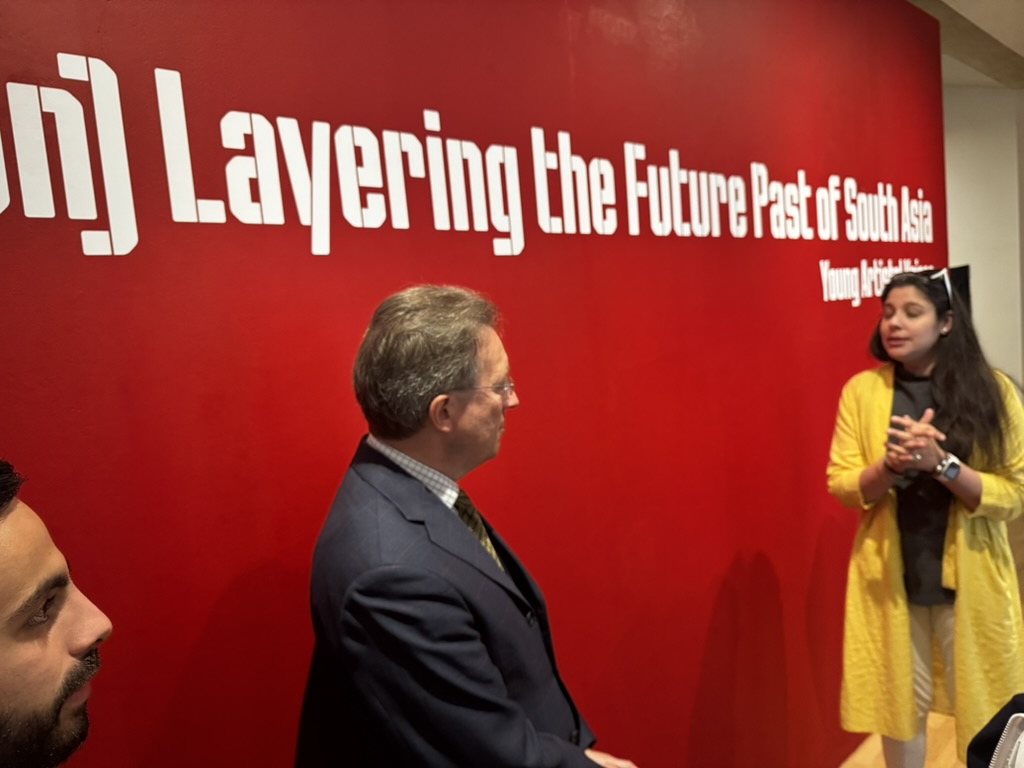
Manmeet K. Walia introducing the (Un)Layering the future past of South Asia: Young artists’ voices‘ exhibit as part of a special event organised by the Bloomsbury Institute London last week. Photo by Beena Sarwar.

The idea of a ‘Young Southasian Artists’ exhibition struck a chord when acclaimed Lahore-based artist and educator Salima Hashmi mentioned it some years ago, after writer and curator Manmeet K. Walia from New Delhi approached her about it.

Salima Hashmi, known for her creativity and longstanding commitment to peace, democracy and human rights, is also a founder member and advisor for the Southasia Peace Action Network which nearly 90 of us launched online in March 2021. Her lifetime of hard work, struggle, and consistency stand apart from the legacy she inherited from her illustrious father, the celebrated poet Faiz Ahmed Faiz.

When Prof. Hashmi and Ms. Walia presented their then under-production show at the Faiz Festival in Lahore, 2024, what stood out was the creativity and courage they were showcasing.

Continue reading

‘I want India and Pakistan to make peace in my lifetime’ – Zehra Nigah

Some thoughts emerging from a chance encounter with one of Pakistan’s most respected and iconic progressive poets.

Indian and Pakistani writers and a filmmaker at the Faiz Festival, Lahore: (l-r) Dr Saif Mahmood, Atul Tiwari, Dr Arfa Sayeda Zehra, Dr Arvinder Chaman, Nandita Das and Zehra Nigah. Photo by Zarminae Ansari / The Joy of Urdu

Personal Political
By Beena Sarwar / Sapan News

“It’s the girls that give me hope,” says the celebrated poet and writer Zehra Nigah.

She leads a quiet life at her home in Karachi, without a mobile phone or email. Yet those who seek her are able to find her. Besides the school and college students who look to her for guidance, there are advertising companies looking for classy jingles. And there are organisers of literary festivals wanting to invite her.

These include Jashn-e-Rekhta, the three-day annual festival that celebrates Urdu — subtly countering the rightwing narrative that Urdu is a ‘Muslim’ language while Hindi is for ‘Hindus’.

When it started in 2015, Rekhta invited several prominent Pakistani poets and writers to participate. Its third edition in 2017 was the first time that there was no Pakistani participation in its sessions – due to the “prevailing atmosphere” in India, the organisers took “a considered decision” to not invite Pakistanis as “participants” but only as “guests”, reported Anita Joshua in the Telegraph, India. 

“Some see in this an instance of self-censorship to avoid trouble of the sort that has recently beset Bollywood films starring Pakistani actors,” commented Joshua.

The only Pakistani who accepted the invitation was Kishwar Naheed, then 77, another iconic Pakistani poet, for whom being invited as a ‘guest’ meant that she would at least be able to recite at the ‘mushaira’, the poetry recital session addressed by several poets, as she told me later. 

Continue reading