As news of Noam Chomsky’s failing health makes the rounds, I share some learnings from my interactions with a trailblazing public intellectual whose moral compass has impacted the world
PERSONAL POLITICAL By Beena Sarwar
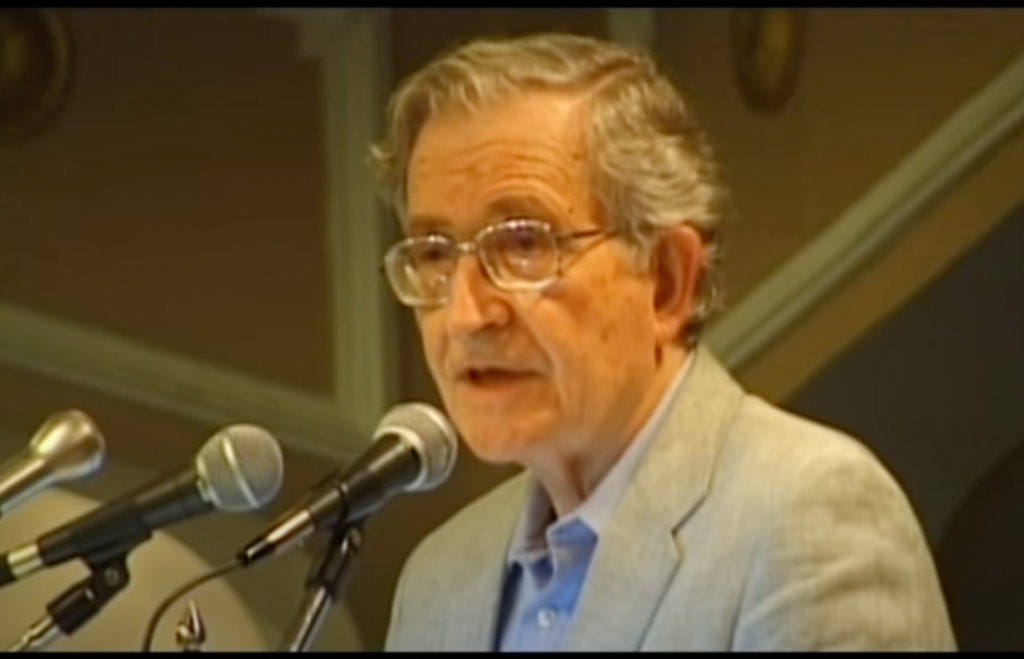
Noam Chomsky in Pakistan, 2001. Screenshot from VPRO news report by Beena Sarwar.
I once asked Noam Chomsky how he manages to remember so many facts and figures and hold audience attention. He replied that he didn’t convey any new information, that his talks are based on materials already in the public domain, and that he simply joins the dots – providing context – and repeats the information consistently and in different ways.
His response was typical of his humility as well as his courtesy towards a much younger person to whom he owed nothing.
Chomsky teaches us that it is not necessary to be loud and sensationalist in order to be heard. This, together with the clear and courageous moral compass he has provided over decades, is a most valuable lesson.
Noam Chomsky was already a legend when I first met him over two decades ago in December 2001 when he visited Pakistan for the inaugural Eqbal Ahmad Memorial lecture series.
A message from the journalist Amitabh Pal about a mutual friend, David Barsamian of Alternative Radio in Colorado reminded me of this piece originally published in The News on Sunday, 8 Oct. 2006, about an event with Noam Chomsky where I first met David. The article is still all-too relevant, but the link no longer works so I’m sharing the piece here without any changes; just added some hyperlinks and photos.
Essential reading – and doing: Eqbal Ahmad
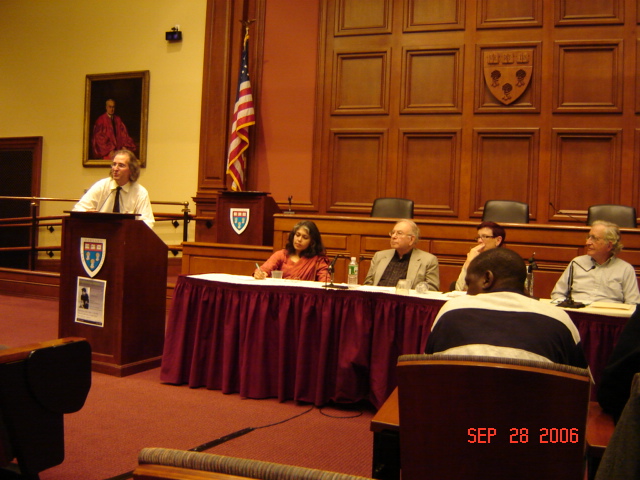
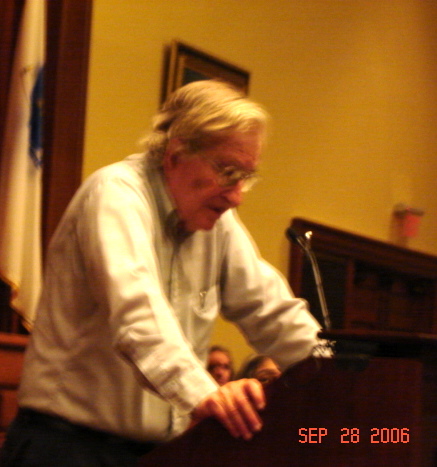
Book launch: The Selected Writings of Eqbal Ahmad, Cambridge, September 28, 2006.
Beena Sarwar
John Trumbour addressing the event. Panel: Beena Sarwar, Stuart Schaar, Margaret Cerullo, Noam Chomsky. Photo: Courtesy MAPA.
When Venezuelan president Hugo Chavez in his address to the UN on Sept 20, held up a copy of Noam Chomsky’s Hegemony or Survival: America’s Quest for Global Dominance (2003) and recommended it as essential reading to understand contemporary world politics, he could have been talking about The Selected Writings of Eqbal Ahmad, for which Chomsky, Eqbal’s long-time friend, wrote the foreword. Chavez identified “the hegemonic pretension of the North American imperialism” as “the greatest threat on this planet” to the survival of the human race.
The book that Jack launched (at HLS)
Chomsky also gave the main address for this collection of Eqbal Ahmad’s writings (Columbia University Press, 2006) at the book’s launch in Cambridge, USA, on September 28. John Trumpbour and Emran Qureshi of the Labor & Worklife Program at the Harvard Law School, who organised the event, didn’t publicise the event too aggressively because of the hype Chavez had generated for Chomsky.
The hall did get quite full, but they didn’t have to turn anyone away at the door. The venue may have had something to do with this. Chomsky, a linguistics professor now retired from the neighbouring MIT, is rarely invited to Harvard. Harvard Law School professor Alan Dershowtiz criticises Chomsky for being too “black and white” but often has to concede the basic truth of the points Chomsky makes.
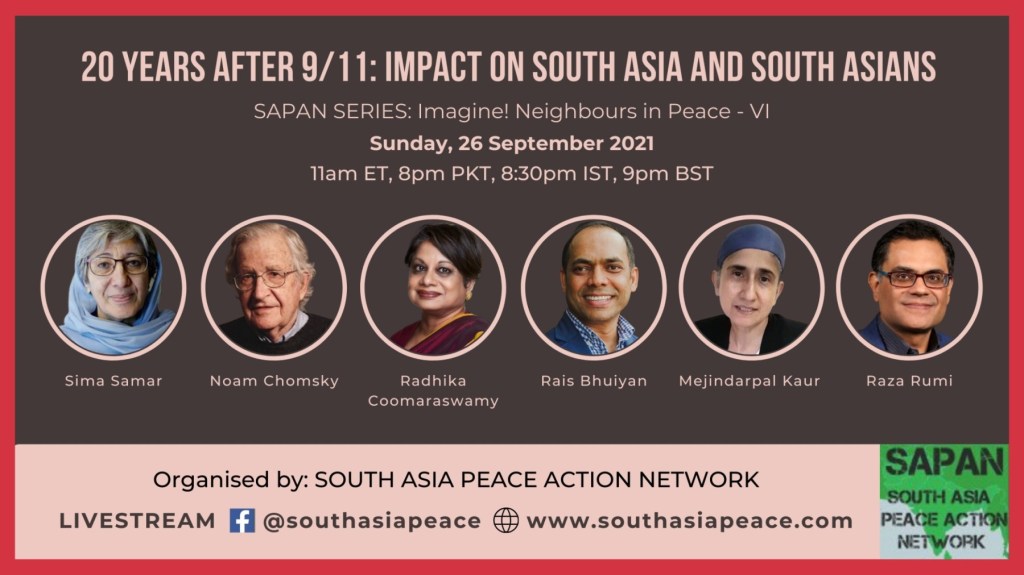
Marking two decades of the September 2001 attacks on New York City, global thought leaders and activists from across South Asia and the diaspora will meet across time zones this Sunday to discuss the impact of “9/11” on the region and its people.
The online event also commemorates the global International Peace Day, September 21.
I wrote this piece a few days back – the second of my occasional syndicated columns. Published in The Wire, Naya Daur, Mainstream, The Citizen among others.
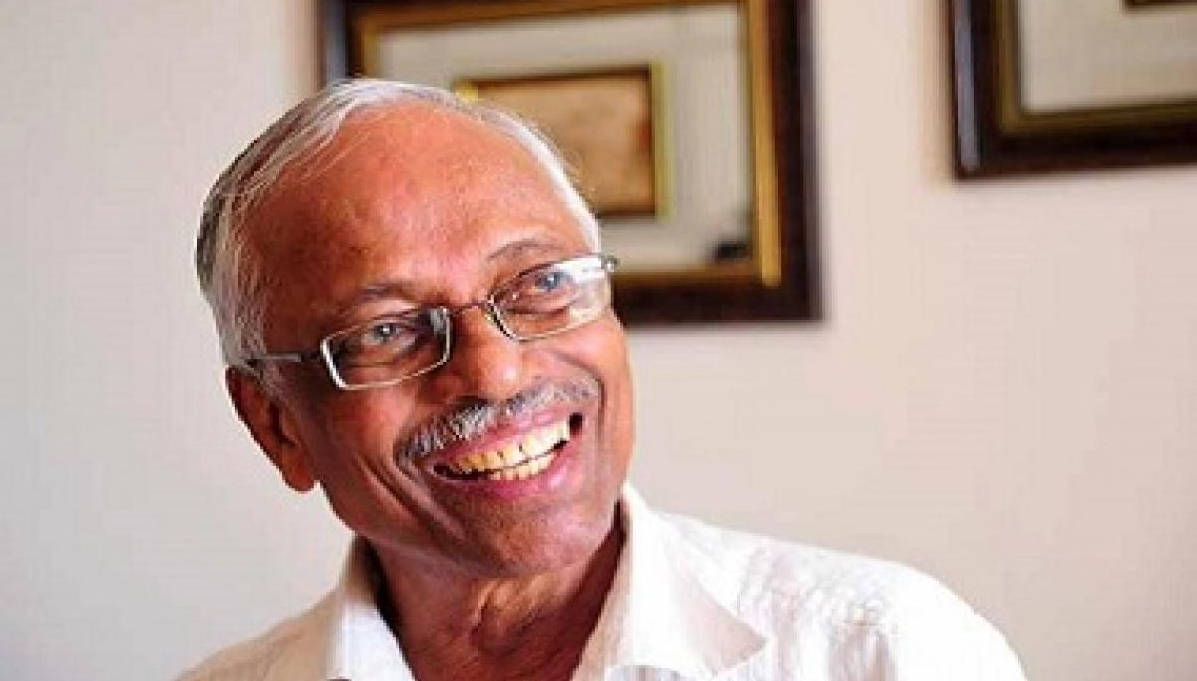
Early Sunday morning in Karachi, a little over a month after his 89th birthday on 18 July 2019, B. M. Kutty slipped into the ever after. Lifelong activist, trade unionist, political worker, peacemonger, humanist. I like to remember him as I last saw him in Karachi – his big smile, deep voice with its powerful timbre, intense gaze behind the glasses, dapper as usual in bush-shirt and trousers.
My article for Scroll.in today about how “Takfiri” thinking drove physicist Abdus Salam out of the country, and keeps Malala Yusufzai away from her home.
Malala: “I decided that I would speak up. Through my story I want to tell other children all around the world they should stand up for their rights”
There is no escaping the irony that the prestigious Nobel Peace Prize for 2014 has gone jointly to two child rights advocates from Pakistan and India – 17-year old Malala Yousafzai and 60-year old Kailash Satyarthi — while the armies of their countries trade bullets and kill innocents across the Line of Control in Kashmir.Continue reading →
Calling all filmmakers: video contest organized by the Eqbal Ahmad Centre for Public Education: Produce and submit 8-minute videos on the theme: “Pakistan: How To Make A Better Future?” Details at this link (text below). Also check out these 8-min videos – impressive compilation.
The competition seeks to raise awareness and encourage activism on important social issues, and encourage the use of new media in Pakistan.
Submissions for 2014 may deal with any of the following:
Citizenship: What are the rights and responsibilities of being a citizen of Pakistan?
Minority Rights: Issues of Pakistan’s religious and ethnic minorities.
Terrorism: Why is Pakistan afflicted and what’s to be done?
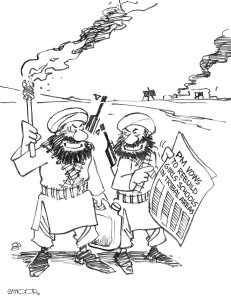
Zahoor: Taliban and the media, in The Frontier Post, June 2008
Those who justify the Taliban uprising in Pakistan as an anti-imperialist movement forget that since the Taliban first swept into Afghanistan in 1996 (with the blessings of the Pakistani establishment), they have been a threat to women, pluralism and democracy in the region. Their oppressive order in Afghanistan pre-dates the American invasion of Iraq, bombing of Afghanistan, and drone attacks in Pakistan –– from an article I wrote in Dawn, 2009. Came across it again while searching for something else. Read it, and tell me, what has changed?
By Beena Sarwar, Feb 7, 2009
OF the many challenges Pakistan’s elected government faces perhaps the most menacing and deep-rooted is Talibanisation — a phenomenon identified earlier on (as Talibanism) by the then exiled Afghan government’s acting foreign minister, Abdullah Abdullah in his address to the United Nations General Assembly on Sept 21, 2000.Continue reading →
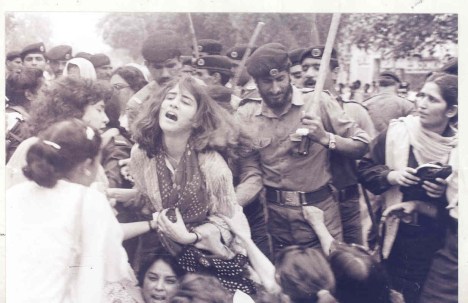
Lahore, Feb 12, 1983: Police lathi charge demonstrators. Photo: Rahat Ali Dar
The News published a slightly toned down version of my article, The Feb 12 pledge. Un-edited text below, followed by a postscript linking this struggle to Malala. More photos at this link.
Renewing the Feb 12 pledge
By Beena Sarwar
Every February 12 we commemorate Pakistan Women’s Day in honour of those who gathered at Lahore’s Regal Chowk on that day in 1983, defying the military order against public gatherings, to protest Gen. Zia’s ‘Law of Evidence’ that upheld the testimony of a male as equal to that of two females in a court of law. The police attacked the demonstrators with batons and arrested several, including the venerated poet Habib Jalib whom Chief Minister Punjab Shahbaz Sharif is fond of quoting.Continue reading →
@salmaantaseer: I was under huge pressure sure 2 cow down b4 rightest pressure on blasphemy. Refused. Even if I'm the last man standing
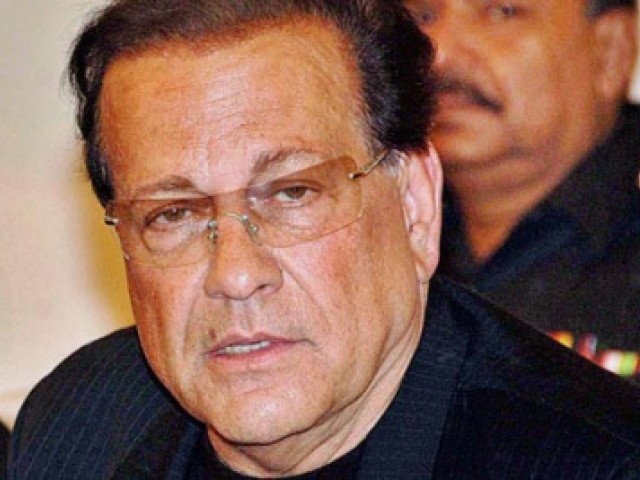
I wrote this on Jan 5, 2010 for Tehelka (published today as ‘Salmaan Taseer’s death is liberal Pakistan’s loss‘), the day after Salmaan Taseer was gunned down in cold blood by his own bodyguard whose cowardly action of firing at the Governor’s back has deprived us of a man of courage and conviction, wit and wisdom. ST, you are not “the last man standing”.
Moving out of the downward spiral
Beena Sarwar
“There are no less than 24 groups as of now supporting Qadri on FB and 1 against what he did, that says it all. #salmaantaseer”.
So went a tweet from a fellow Pakistani early morning on Jan 5, the day after the assassination of Salmaan Taseer, the governor of Punjab who took a courageous stand against religious extremists in Pakistan.
The facebook pages cropping up don’t quite say it all. Facebook is usually quite slow to take action against pages that users consider abusive (unless they have to do with Israel). In this case, many of those pages (mostly started by young men who like western shows like Sex and the City, support Pervez Musharraf and say they follow Islam – any contradictions here?) were taken down within 24 hours – which means that enough people reported them as abusive.
When it comes to religion, there is confusion in people’s minds in Pakistan. This confusion has been building up over the years, particularly since America, Saudi Arabia, Pakistan and their allies took up cudgels against the Communist threat in Afghanistan and injected religion into the Afghans’ war of liberation against the Soviet invasion. Calling it a ‘jihad’ or a holy war enabled them to draw in Muslim fighters from around the world. The late Eqbal Ahmad warned against this long before the horrific events of 9/11 and US President Bush’s immature response sent the world into a downward spiral of violence, especially Pakistan, the frontline state in America’s war first against the Communists and then against extremist Islam.
The questions arising from Taseer’s assassination indicate that some forces in Pakistan are continuing along the old trajectory. The assassin, 26-year old Malik Hussain Qadri, was assigned to the elite force guarding the Punjab Governor. It now emerges that he had been removed from the Special Branch because he was perceived as a security threat – so how did he end up on the security detail of a Governor who was already receiving death threats?
According to the post-mortem, he fired 41 bullets into Taseer’s back while the Governor was getting into his car. He then threw down his weapon and raised his arms in surrender.
Standard operating procedures in VIP guard duty require the other guards to immediately open fire even if the assailant is one of them, explains my military analyst friend Ejaz Haider. So why did the other guards not follow the SOP?
Chillingly, Qadri has revealed that he had told his colleagues what he was going to do and asked them not to open fire, as he would surrender. Which means that he was confident of getting away with it.
“Now the judicial process will take over,” predicts Haider. “The judge/prosecutors will be threatened, and the murderer will be declared a hero.”
This is of course already happening, as the facebook pages show. Some of them have referred to him as a ‘ghazi’ (conqueror) and are justifying and glorifying his murderous act – including several religious organisations. In fact, some have gone so far as to say that because he was ‘guilty’ of ‘blasphemy’, no Muslim should lead or attend his funeral prayers.
Qadri’s smiling face was flashed on television channels, along with his comments that “Salmaan Taseer is a blasphemer and this is the punishment for a blasphemer”. He is reported to have told interrogators that the Governor had called the blasphemy laws ‘black’ and had defended Aasia Noreen, the Christian woman sentenced to death for ‘blasphemy’.
Taseer’s role in highlighting the Aasia Bibi case, as it came to be known, was significant although some have criticised his high-profile visit to her jail cell and his promise to obtain a presidential pardon for her, which circumvented due process. According to due process, the President’s pardon would have been sought after the Supreme Court confirmed the death sentence following the High Court’s confirmation of it.
The Pakistani state has not executed any blasphemy convicts because so far, the High Courts or the Supreme Court have acquitted those accused under this law (295-C, imposed by Gen. Ziaul Haq to add to 295-A that existed since British times). Yet the mere allegation of ‘blasphemy’ has been enough to incite the murder of over 30 people so far. Taseer’s is the most high profile such murder.
Given the current climate, it is unlikely to be the last. For things to significantly change, ‘deep state’ will have to change its policies of support for ‘jihadis’ and jihadi mind-sets.
Meanwhile, those who have been opposing the blasphemy laws and other injustices perpetuated in the name of religion will continue to protest, as they have been doing for decades.
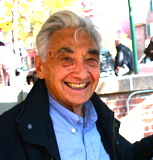
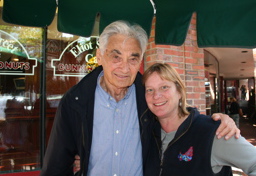
The Zinn magic. Photo: BJ Bullert, Cambridge MA, 2006
“To be hopeful in bad times is not just foolishly romantic. It is based on the fact that human history is a history not only of a cruelty but also of compassion, sacrifice, courage, kindness”
– Howard Zinn
Howard Zinn’s death on Jan 27 came as a shock to his friends and admirers around the world. The iconic historian, activist, and academic (Professor Emeritus, Boston University) was 87, frail, but in reasonable health. He had a heart attack while swimming, an activity he loved. As Arundhati Roy put it when she called his old friend David Barsamian of Alternative Radio: “Howard lived a glorious life and accomplished so much and to die swimming — what a way to go”.
Howard Zinn, Cambridge, Oct 2006 (photo: BJ Bullert)
David writes that Howard had rented a place with a swimming pool near the ocean for three weeks and “was thrilled to be escaping the dreaded Boston winter.”
A fluent Urdu/Hindi speaker, David sent this note to friends: “A light has gone out. There are new lights to be lit,” adding the following verse from Iqbal’s poetry:
Sitaron se aage jahan aur bhi hain abhi ishq ke imtehan aur bhi (Beyond these stars there are other galaxies The real test of love is yet to come)
In November when he visited Howard David noticed a mug in his kitchen with these words: ‘Sooner or later the American people are going to wake up’ – Emma Goldman, Detroit 26 Nov 1919. “
The book that Jack launched (at HLS)
It was going to be my lead question to him in the interview we were going to do,” wrote David. “I was to have left here on Thurs to join him.” (Howard died on Wednesday).
David sent a link to his radio tribute to Howard adding, “Please listen and of course feel free to distribute. It’s about 30 minutes.” His note ended rousingly: “Onward/Adelante/Howard Zinn Presente!”
We had been in email contact for some time but I met David for the first time at the launch of Eqbal Ahmad’s collected essays published posthumously by Columbia University Press in September 2006. The launch took place subversively at Harvard Law School – subversively because HLS is a rather conservative place where the views of people like Eqbal Ahmad and his friends and comrades – David Barsamian, Howard Zinn, Noam Chomsky to name some – are rarely heard (particularly in the context of the Middle East, Palestine, Israel). But some pockets of resistance exist in those gilded halls. They include John Trumpbour (Jack), Research Director at Labor & Worklife Program, Harvard Law School.
Jack introducing the Eqbal Ahmad book launch and panelists. R-L – Chomsky, Margaret Cerullo, Stuart Schaar & me.
Jack, who organised the launch, invited me to be on the panel (I was then a fellow at the Carr Center for Human Rights Policy, Kennedy School). David flew in from Colorado for the launch. Noam Chomsky, a long-time friend of Eqbal’s, gave the main speech. (I sent my report on the event reproduced at Pakistaniat to Howard – he replied: “That’s a lovely story, with wonderful photos!”)
There was pin drop silence as Chomsky spoke in his characteristic low key way.
Chomsky was of course also an old friend of Howard Zinn’s. In an email responding to my note of condolence he wrote: “It is a sad moment, not just personally, but for wide circles far beyond his family and many friends. A really remarkable person, just as you say, as well as a close personal friend for many years.”
Jack recalls his last meeting with Howard, whom he had invited to teach at a class at the Harvard Trade Union Program in January, just a couple of weeks earlier. “Howard had lost some significant weight in the last year, but he was energetic and engaging as always. He showed a lot of clips from the new history movie he helped make, including appearances by Bob Dylan and Bruce Springsteen.”
Jack Trumbour and Howard Zinn: photo by Canadian labour leader Nancy Hutchison, taken on Jan 15, after Howard finished teaching the Program.
“Many people know about Howard’s peace activism, but fewer know about his efforts to reach workers and the labor movement,” comments Jack.
“Howard had a lot of issues with serious back pain during the past year, and he had some significant medical attention for this. He indicated that he was doing better, though not great… There have been some fine tributes to Howard. And the bloggers at the nasty right-wing website of David Horowitz have sneered at him, which is to be expected.
“…This is a sad day for us all, but we are hoping Howard’s tireless advocacy for peace might inspire others in 2010 to build a movement that can stop the madness, madness which includes Obama’s support for more global interventions.”
“I would try to be fair to other points of view, but I wanted more than ‘objectivity’; I wanted students to leave my classes not just better informed, but more prepared to relinquish the safety of silence, more prepared to speak up, to act against injustice wherever they saw it. This, of course, was a recipe for trouble” – Howard Zinn in his autobiography, You Can’t Be Neutral on a Moving Train (1994).
Cambridge, Oct 2006: Howard Zinn and B.J. Bullert. Photo: Beena Sarwar)
Jack was indirectly responsible for my own meeting with Howard Zinn. In May 2006, he had connected me with BJ Bullert, a documentary filmmaker in Seattle, WA, a graduate of Boston University (BA, Philosophy) with an MLitt in Politics from Oxford, with a PhD in Communication (University of Washington). She was interested in finding out more about the Tarbela Dam (her father was an engineer there and she had lived in Pakistan as a 13-year old) and issues of displacement (That is another story).
When BJ visited Cambridge in October 2006, we met for the first time since we had started corresponding. Later, when going to meet Howard, her old teacher, she invited me also. I was thrilled, and took along my copy of his inspirational, best selling book ‘A People’s History of the United States’. The book, currently #4 on the NYT non-fiction best-seller list, has sold more than a million copies and “redefined the historical role of working-class people as agents of political change” (as the LA Times obituary put it).
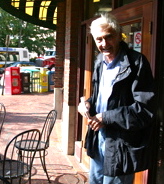
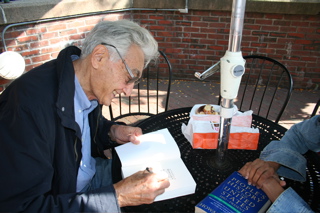
Howard Zinn autographs my copy of People’s History…
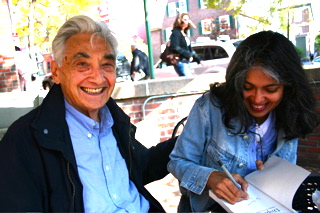
... and graciously makes me sign my offering. Photos: BJ Bullert
We sat outside in the little courtyard at Dunkin’ Donuts opposite the Kennedy School and talked, and joked. He graciously signed my copy of his book and even more graciously asked me to sign a copy of a book I gave him, ‘Dispatches from a Wounded World, (BlueEar & BookSurge, USA & UK, December 2001, to which I had contributed a chapter, ‘The Hijacking of Pakistan’, pushed by Ethan Casey). We joked, bantered and exchanged ideas. Jack turned up later to join us. Howard then had another appointment and we all went on our own ways. But we kept in touch.
Howard was prompt to endorse the ‘Academics’ Statement Of Support For Dr Ayesha Siddiqa’ in June, 2007, after the Musharraf government attempted to intimidate Ayesha following the publication of her book ‘Military Inc.: Inside Pakistan’s Military Economy’. The establishment pressurised the Islamabad hotel where the launch was scheduled to cancel the event. Ayesha’s phone service was disrupted as she gave interviews and she felt increasingly isolated and physically threatened.
The statement reminded the Musharraf administration “that the whole world is watching. The aspirations of the vast majority of the Pakistani people are inclined towards democracy and freedom of expression. It is obstructing these aspirations that will ‘derail the nation from its path of progress and prosperity’ to use a phrase from the press statement issued after the corps commanders meeting.”
Howard was generous in his appreciation for an oped I wrote for the Boston Globe about Pakistan’s struggles a couple of weeks later, saying it gave him “a clearer picture of what is going on in Pakistan, which of course I cannot get in the media.” (I think he meant the ‘mass media, particularly television, because after all, the Globe is media…).
In December 2007, I emailed BJ, Jack and Howard when David Barsamian visited to Pakistan for the Eqbal Ahmad Distinguished Lectures and needed some contacts. “Somebody ought to make a film about David,” quipped BJ.
David Barsamian at T2F (1.0) with Sabeen and Zak listening to an audience comment (March 2008). Photo: beena sarwar
Howard replied playfully, “BJ, a film on David Barsamian is a great idea. You will interview me and I will tell the world what a scoundrel he is. But seriously, you should do it! He deserves it, scoundrel that he is.”
In April 2008, the indefatigable e-campaigner Isa Daudpota emailed a Zinn quote to his mailing list, formatted as a poster that he had put up on his office door:
We need Civil Disobedience!
“Civil disobedience is not our problem. Our problem is civil obedience. Our problem is that numbers of people all over the world have obeyed the dictates of the leaders of their government and have gone to war, and millions have been killed because of this obedience. Our problem is that people are obedient all over the world in the face of poverty and starvation and stupidity, and war, and cruelty. Our problem is that people are obedient while the jails are full of petty thieves, and all the while the grand thieves are running and robbing the country. That’s our problem.”
~Howard Zinn
“Well, that’s nice news about the poster! In Islamabad!” exclaimed Howard when I forwarded it to him.
I visited Cambridge soon afterwards. His wife was ill and he tried to stay home as much as possible. But he added cheerily, “Hope you come back and we’ll have another chance to get together.”
I learnt in September from David that she had passed away soon afterwards. In response to my note of condolence Howard replied: “Roz was diagnosed with ovarian cancer in July of 2007, had six very good months, refusing surgery and chemotherapy, then declined and died in May. lt’s hard, but I’m doing okay.”
Married in 1944, they were inseparable until Roz’s death in 2008. She was also an activist, and Howard’s editor. “I never showed my work to anyone except her,” Bob Herbert quoting him as saying, in his obituary for the NYT.
Howard’s energy was amazing. Shattered by his wife’s passing away, himself well over 80 years old, he continued to write, give talks and interviews. He also embraced new ways of getting the word out, as evident with the publication of ‘A People’s History of American Empire’, the comic book version of “The People’s History of the United States” in 2008 that combines cartoons, historical documents and photos, “making the whole thing visual, dynamic, and absolutely captivating,” as one review put it.
The last email I got from him was about yet another exciting project to spread these ideas and awareness, through the documentary, THE PEOPLE SPEAK. He sent an email out to his contacts about the screening of this film, “directed-produced by Chris Moore, Anthony Arnove, myself, with a great cast of readers and performers. That will be Sunday evening, Dec. 13, 8 PM (7 PM Central) on the History Channel.”
A must-read for any Zinn fan is ‘the most dangerous man in America’ Daniel Ellsberg’s riveting tribute. He recounts that he first met Howard Zinn at Faneuil Hall in Boston in early 1971, “where we both spoke against the indictments of Eqbal Ahmad and Phil Berrigan” for “conspiring to kidnap Henry Kissinger”. He recalls how Howard (who had been arrested in D.C.) returned to Boston for a rally and a blockade of the Federal Building, and was the last speaker at a large rally in Boston Common being addressed over loudspeakers.
Ellsberg writes: ‘Twenty-seven years later, I can remember some of what he said. “On May Day in Washington, thousands of us were arrested for disturbing the peace. But there is no peace. We were really arrested because we were disturbing the war.”
At the end, he said: “I want to speak now to some of the members of this audience, the plainclothes policemen among us, the military intelligence agents who are assigned to do surveillance. You are taking the part of secret police, spying on your fellow Americans. You should not be doing what you are doing. You should rethink it, and stop. You do not have to carry out orders that go against the grain of what it means to be an American.”
He paid for his words the following day when he was singled out for manhandling and arrest.
As the legendary activist and author discussed in one of his final interviews, he wants to be remembered for “introducing a different way of thinking about the world,” and as “somebody who gave people a feeling of hope and power that they didn’t have before.”
Howard Zinn, wherever you are, know that there are people here too who will always celebrate your life and work and who mourn your passing away as a world citizen who cared for humanity above all and did indeed give people “a feeling of hope and power”.
Compilation of tributes and articles related to Howard Zinn, including his own works, at the Howard Zinn website.
Post script: Just came across Mahir Ali’s tribute to Zinn in Dawn, Feb 10, 2010: ‘Lessons from a past master‘ – “Every country would be well-served by a radical public intellectual of comparable erudition, commitment, wit and wisdom. Americans should be very proud of Howard Zinn.”






 Journeys to democracy