The cross-border solidarity of Amrita Pritam and Fahmida Riaz, the student movement, and peacemongering today

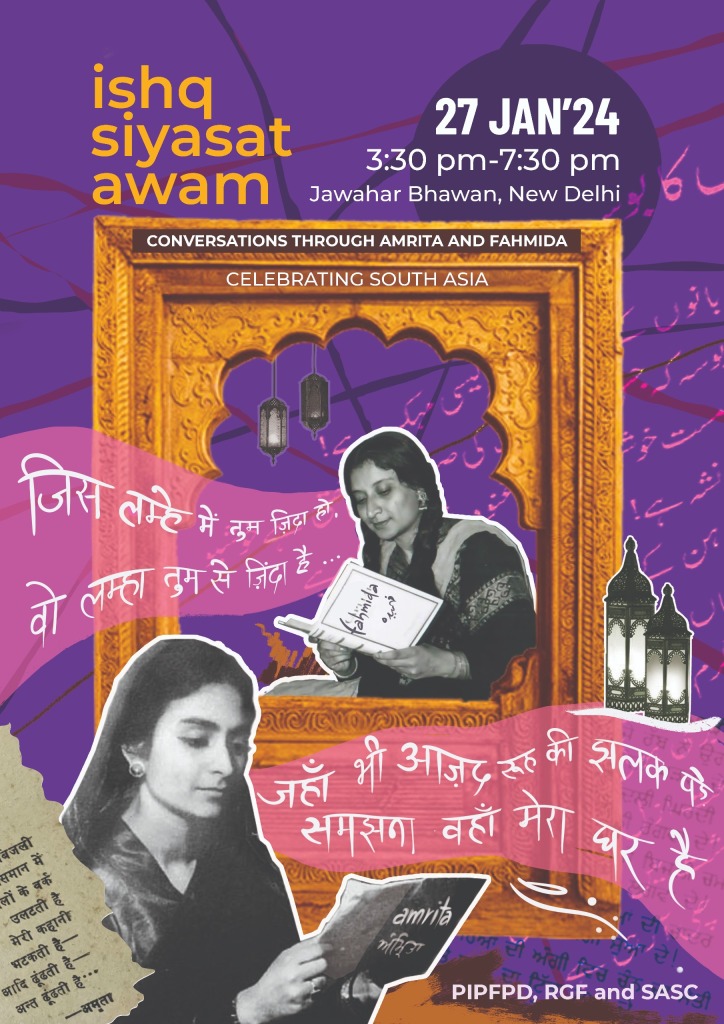
Poster for the event honouring Amrita Pritam and Fahmida Riaz. Courtesy PIPFPD

The latest Southasia Peace Action Network (Sapan) newsletter we put out highlighted a commemoration in Delhi for two iconic feminist poets of Pakistan and India: How the friendship of two cross-border feminist poets symbolises our work; upcoming events, and more

Radical love, epitomised by the late Amrita Pritam and Fahmida Riaz is ‘one of the seeds of the revolutionary thought process’, to quote the Pakistan India People’s Forum for Peace and Democracy (PIPFPD) stalwarts who organised the event – Vijayan MJ, Tapan Bose, and Dr Syeda Hameed. Their consistent work over the decades for peace and justice is truly inspirational, and I feel privileged to know them personally.

I was also privileged to know one of the late poets personally, Fahmida ‘Khala’ (aunt) to me, who was close to my father Dr. M. Sarwar. He led the Democratic Students Federation (DSF), Pakistan’s first student movement while at Dow Medical College in Karachi, 1949-54.

I’ve uploaded archives about the movement here: drsarwar.wordpress.com. Principles of that struggle continue to show the way, like the importance of coming together across divides for a minimum common agenda. For DSF, it was student rights. For Sapan, it’s Southasia Peace. We need it now, for the sake of the people of the region, and beyond. 

The Videos section of the Dr Sarwar blog includes a playlist of video clips from the event held at the Karachi Arts Council in January 2010 to commemorate DSF and the student movement, a few months after my father passed on.

Compered by the actor Rahat Kazmi, the event featured speeches from young activists, students, and academics like Amar Sindhu, Alia Amirali, Ali Cheema, and Varda Nisar, as well as veterans like I.A. Rehman, besides the singer Tina Sani, Taimur Rahman and his band Laal, and Fahmida Riaz.

Fahmida Khala recited her poem ‘Palwashey Muskurao’ (Palvasha, smile), dedicated to daughter of late Afzal Bangash of the Mazdoor Kissan Party (Workers’ and Peasants’ Party), and the followers of other late leftist leaders. They may no longer be on this earth, but their principles and aspirations for human rights and dignity continue to show the way.

Fahmida Riaz reciting her poem ‘Palwashey Muskurao’ (Palvasha, smile), Jan. 2010, Karachi.

(ends)

A social worker, an economist, and the legacy of Pakistan’s student movement of the 1950s

OBITUARY: The legacy of a decades-old connection between social worker Shahida Haroon (1937-2023) and economist Eric Rahim (1928-2023) endures through the ongoing struggle for student rights, economic justice and democracy in Pakistan

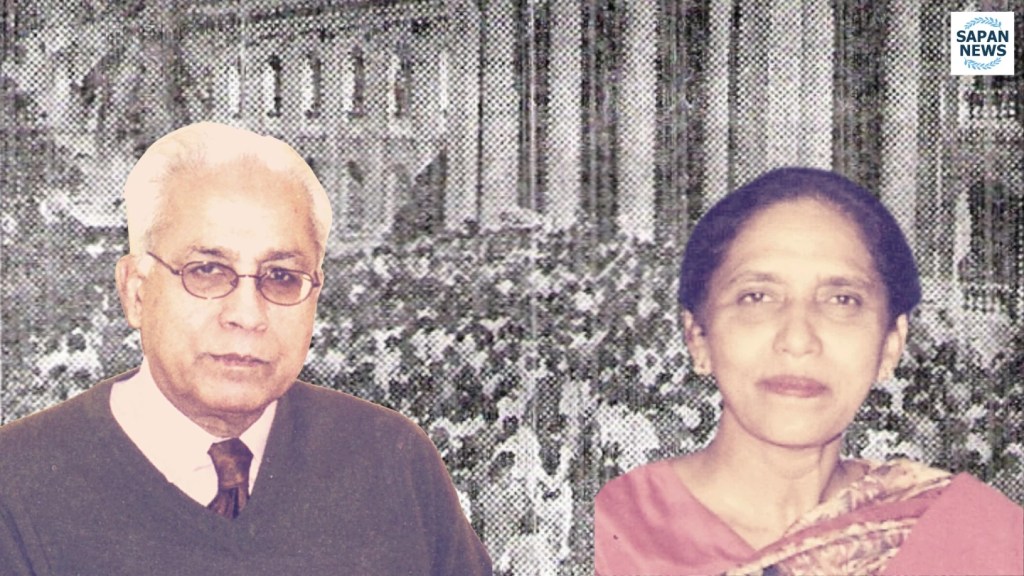
Demands Day at D.H. Science College, 07 Jan. 1953, Eric Rahim, Shahida Haroon Saad. Collage by Aekta Kapoor/Sapan News

PERSONAL POLITICAL

By Beena Sarwar / Sapan News

It was while trying to reach Eric Rahim in Glasgow this week to inform him of my aunt Shahida Haroon’s passing in Karachi that I learnt he too was no more.

A respected journalist and economist, Uncle Eric as I called him, had passed away peacefully at home on 2 May 2023, aged 94. He was a mentor to my father Dr M. Sarwar (1929-2009), and Shahida, who departed this earth on 25 June, at 87.

Shahida did her Master’s in economics from Karachi University in 1958, a subject she didn’t enjoy or do well in. When she went to Punjab University for a second Master’s in social work, encouraged by her brothers Akhtar, 11 years older, and Sarwar, eight years older, Akhtar asked his friend Eric Rahim to look after her. It was Eric, then a columnist at The Pakistan Times, who met Shahida at the train station after her overnight journey.

Continue reading

A beloved jurist passes on

Fakhruddin G. Ebrahim (12 February 1928-7 January 2020) gained respect early on in his career for refusing to take oath under the military dictatorship of Gen. Ziaul Haq. Through his life he wore many hats — founder member Human Rights Commission of Pakistan, Pakistan Supreme Court judge, Governor Sindh, Chief Election Commissioner, to name some. But a little-known feather in his cap is his pro bono work for the imprisoned leftist and student activists of the 1950s, that he credited for his politicisation. Those, he would say, were “the best days” of his life. Here’s that story as I heard it from him and from my father Dr. M. Sarwar, published in The News on Sunday and The Wire a few days after Fakhru Uncle passed on.

Fakhruddin G. Ebrahim: A fine legacy (online photo)

By Beena Sarwar

As the debate on the much-delayed restoration of student unions in Pakistan gathers momentum, we celebrate and commemorate a beloved jurist who cut his teeth by taking on cases of detained student activists pro bono in the 1950s.

Continue reading

Former DSF activist Dr Ghalib Lodhi makes a quiet exit

Dr Ghalib Lodhi (left) with Dr M. Sarwar, London, 2001.

Karachi, Aug 3, 2012: Tahir Wasti in London emailed recently that Dr Ghalib Lodhi expired in Karachi. I contacted some of Dr Ghalib’s old comrades. None of them had heard of his demise…

Former DSF activist Dr Ghalib Lodhi makes a quiet exit.

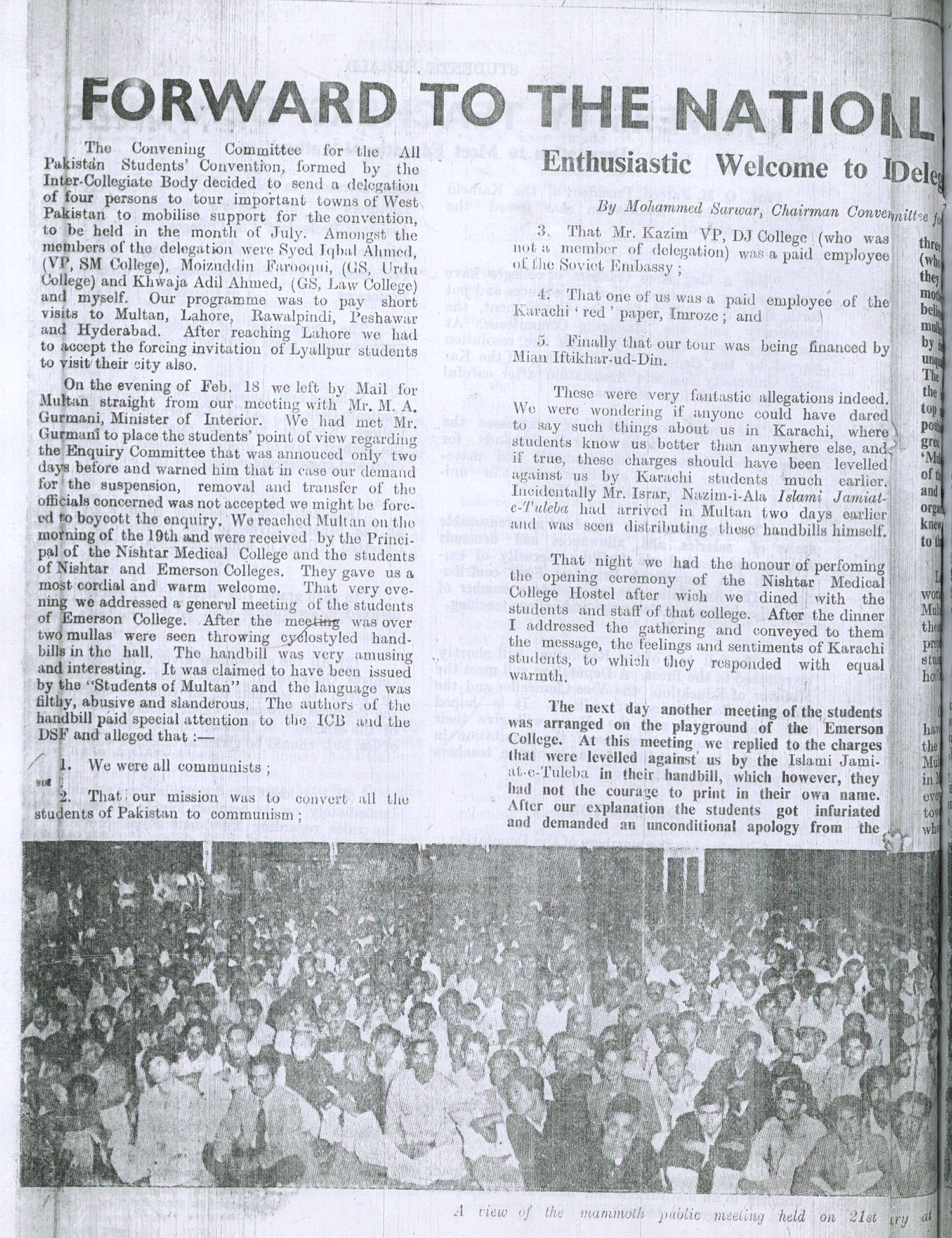
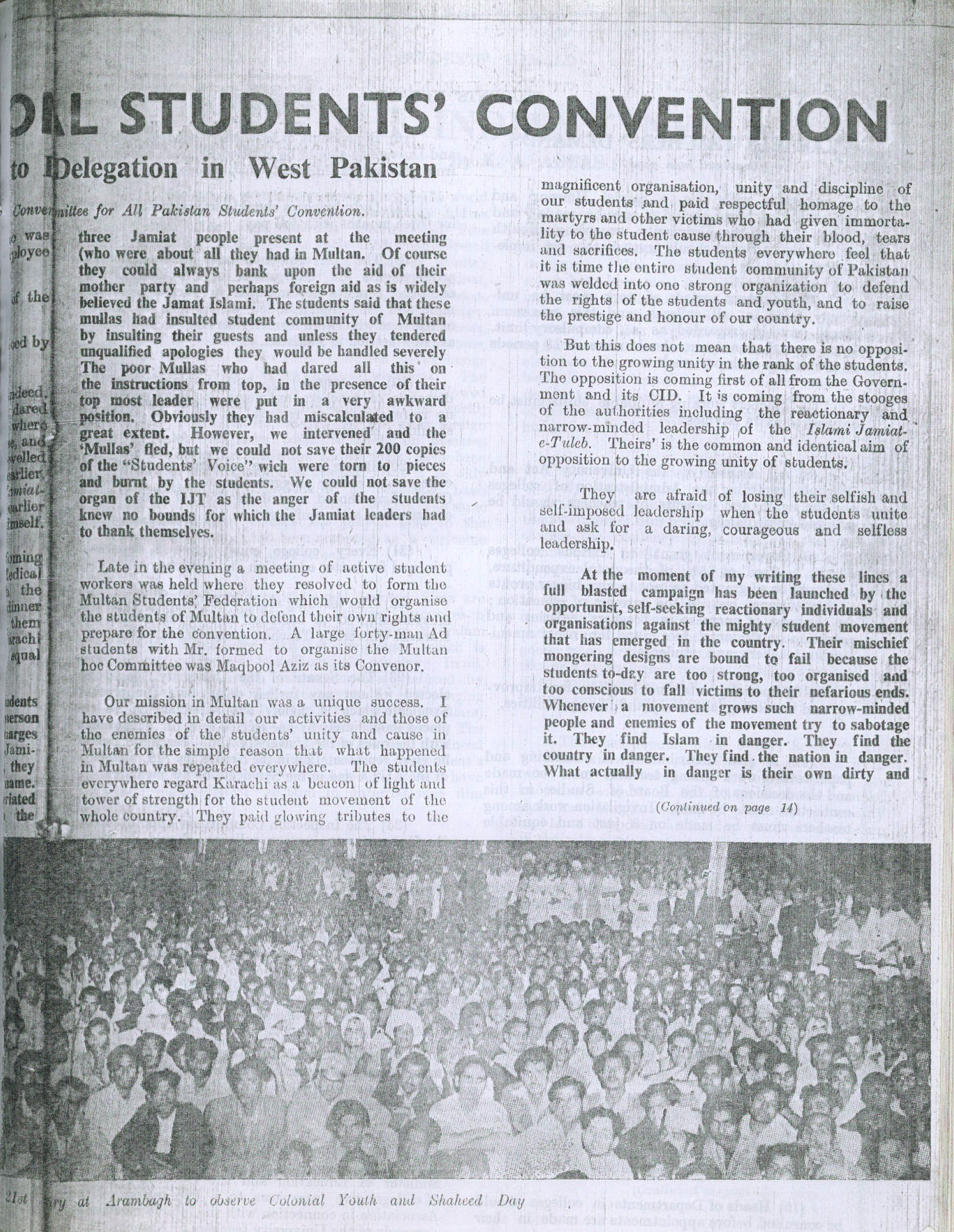
Commemorating the January 1953 movement and a story about Karachi students inaugurating a Multan hostel

Here is an interesting story from the 1953 student movement, about how they contacted colleagues and supporters in other parts of the country in an age when communication was far slower and more expensive than it is now. Continue reading

Dr Sarwar blog; my ‘Media Matters’ chapter in new book on Pakistan India divide

Hello all, it’s been a while since I last posted anything to this list. Have been caught up in a bit of a backlog.

Have uploaded new material, including photos, to the Dr Sarwar website – www.drsarwar.wordpress.com

Please do check it out. Suggestions, comments and inputs welcome

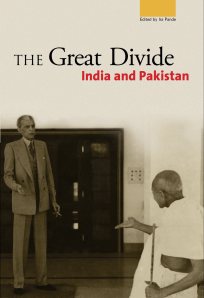
Cover 'The Great Divide'

Cover 'The Great Divide'

Recently received a copy of the India International Center quarterly to which I contributed a chapter (excerpt below), published recently by Harper Collins, India. I dipped into it – loved the chapter by Sonia Jabbar & was happy to see that Mukul Kesavan, one of my favourite writers, also has a chapter, besides other luminaries like Urvashi Butalia, Amit Baruah (former The Hindu correspondent in Islamabad),and Pervez Hoodbhoy plus a short story by Danial Muinuddin.

‘The Great Divide: India and Pakistan’ (Hardback, 360  pages)
Edited by Ira Pande
ISBN: 9788172238360
Cover Price: Indian Rs. 495.00

http://www.harpercollins.co.in/BookDetail.asp?Book_Code=2313

BOOK SUMMARY
At a time when India and Pakistan are both reeling under terror attacks and hysterical talk of an impending war, it is important to take stock of where we have reached, individually and as part of the Indian subcontinent; sixty years after the two nations were carved out as two distinct entities.

This volume of essays by writers from both sides of the border attempts to do just that. As the editor, Ira Pande, says in her introduction, ‘There is a balance here between the ‘hard’ topics (politics, economy, diplomacy, religion et al) and ‘soft’ (music, crafts, language, cricket, cinema) to bring out the full range of our engagement with each other.’

Below: Excerpt from my chapter

‘Media Matters’

Beena Sarwar

(excerpt begins)
Ask anyone what they think the major problems in society are, and chances that the media will figure somewhere in the answer. Ask about possible solutions and the answer again will include the media in some way. So is the media part of the solution or part of the problem? Or is it, as some think, the problem itself? Do journalists simply mirror society – reflect the good and the bad — or do they actually shape perceptions and agendas? Equally crucially, do they act independently or do they ‘manufacture consent’ for their governments and corporate owners? Have the media contributed to rising tensions between South Asia’s nuclear-armed neighbours, or are hostilities between the countries contributing to tensions between their media? Has the media boom brought people closer, or is it driving a greater wedge between them?

The answer is ‘yes’, to all these questions.

The ‘media’ of course are not a monolithic entity. The news media includes print, television, radio and more recently the ‘new media’ – websites and web logs or ‘blogs’ posted on the Internet. The ‘popular’ or ‘entertainment’ media includes film and advertising. Crucial to the role of the media is the continual blurring of the line between the news and entertainment media.

The media boom has on the one hand brought the people of India and Pakistan closer together and contributed to shattering stereotypes. On the other hand, it has done just the opposite, reconfirming prejudices and old suspicions.

The 24/7 news media boom has also spawned a beast that thrives on 30-second sound bites and shrinking attention spans around the world. It is not big on in-depth analysis and prefers speculation. It tends to bypass contextualisation for quick updates. The race to be the first to ‘break’ the news often leads to misreporting and inaccuracy. Peace talks and negotiations which would be more effective away from the media spotlight are routinely sabotaged by leaks and overreactions to those leaks.

Broadcasting belligerent statements by one politician or other is damaging anyway, but worse when these are cross-border taunts and challenges. The media has a duty to report, but giving weight to negative statements and events contributes to the hardening of stances and reinforcing of negative stereotypes. Of course, it also exposes the belligerent nature of those making such statements for all to see.

(excerpt ends)