Horrific murder of Turkish girl reflects distorted notions of honour

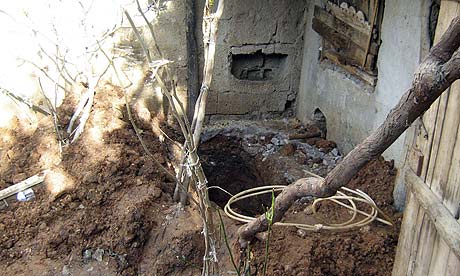
The hole where a 16-year-old girl was buried alive by her relatives in Adiyaman, southeastern Turkey Photograph: HO/REUTERS (courtesy: The Guardian - report below)

Recently there was a report about the horrific murder of a Turkish girl, whose family buried her alive because she was talking to a boy. Turkey’s shame… but she’s not alone. Such incidents take place regularly in conservative, patriarchal societies that face all kinds of conflict in this day and age, among communities that have distorted notions of ‘honour’. ‘Honour killings’ take place in Muslim-majority Pakistan but similar stories also emerge from Hindu-majority India, where such murders take place among those belonging to the Hindu or Sikh faiths (often when the girl or boy involved belongs to a ‘lower’ caste), not just Muslims. I believe the issues are related to power and patriarchy. Religion is just a tool in that game, as are notions of ‘honour’. As I wrote when a similar case emerged in Pakistan (four women buried alive in Balochistan for wanting to marry of their own choice), there is no honour in killing. Below: text of the report that appeared in The Guardian, by Robert Tait in Istanbul, Feb 4, 2010:

Turkish girl, 16, buried alive for talking to boys

Death reopens debate over ‘honour’ killings in Turkey, which account for half of all the country’s murders Continue reading

Combatting corruption with ‘zero’, Bindiya Rana, and more

This post is based on a note I began compiling over a week ago, sent to my yahoogroup the other day, which includes links to some articles on corruption and politics and a somewhat related note on Bindiya Rana, the Khwaja Sira (hijra) who features in Ragni Kidvai’s film ‘Bindiya Chamke Gi’…

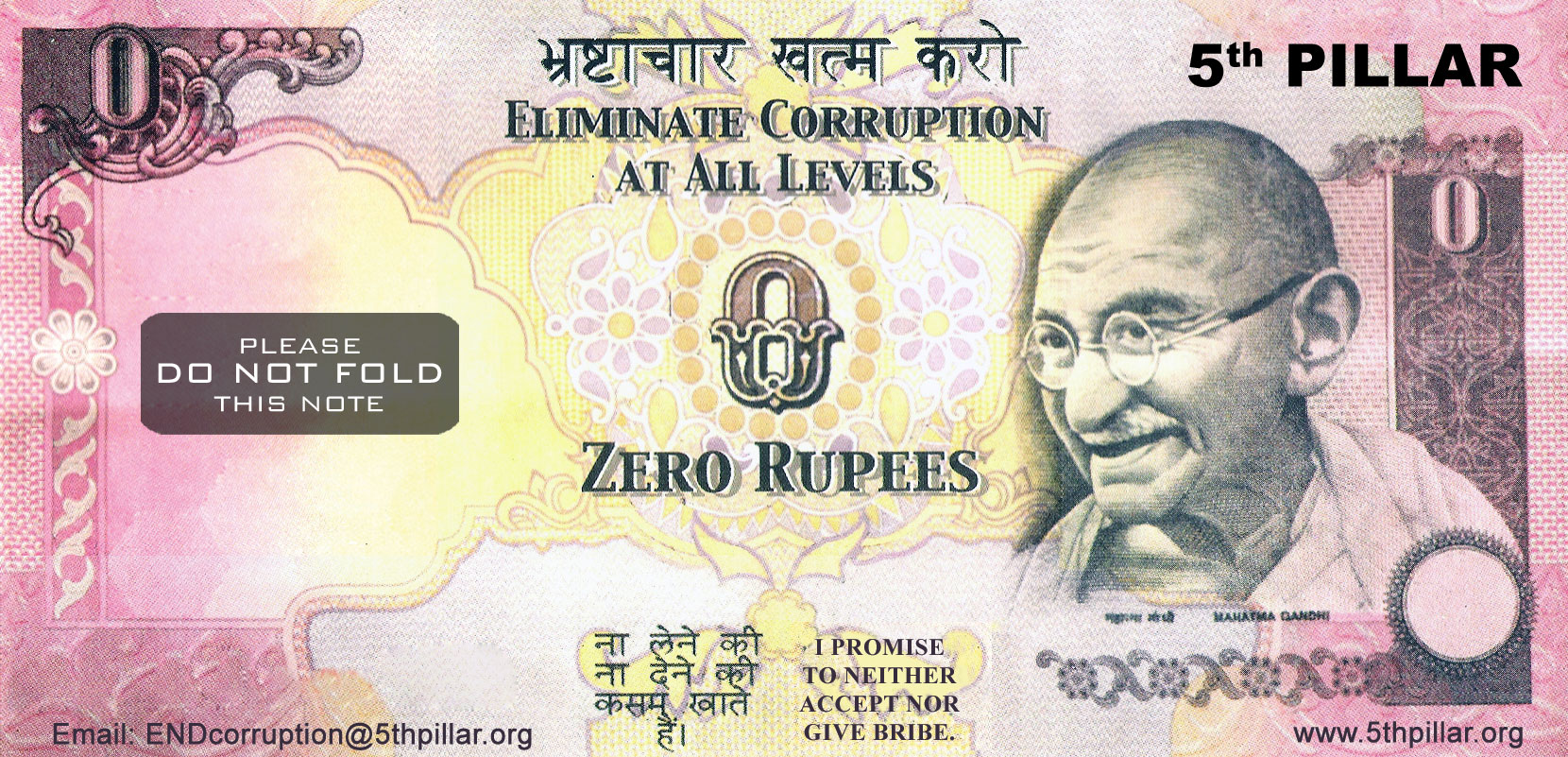
‘Paying Zero for Public Services’: An Indian NGO called 5th Pillar gives the public a powerful ally, an imaginative way to combat petty corruption: a zero rupee note (“eruption against corruption”! – love it). Why can’t we do this in Pakistan?  (thanks Omar Ali)

Speaking of corruption: “The NRO judgment cannot be all about the evil in Asif Zardari. It must be seen on its own. It is a reminder of the time when the military’s illegal acts against Nawab Akbar Bugti were being tolerated because the latter was an unsavoury person” – Flaws in the judgment‘ by Asma Jahangir
Continue reading

“We Refuse to Be Held to Ransom By Terrorism”: Veena Masud, Pakistan Women’s Swimming Association

Mic announcing & diver2

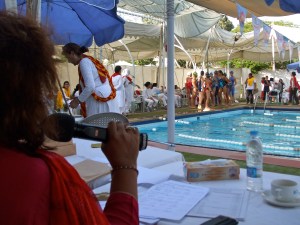
Veena Masud announcing at a national swimming meet, Karachi, May 2009. Photo: Beena Sarwar

I’ve been wanting to do a report on Pakistan’ women swimmers since March 2009, when I first heard Veena Masud speak at a Szabist seminar in Karachi.

Q&A with Veena Masud below; don’t miss the Footnote at the end, includes reference to an old Shoaib Hashmi & Samina Ahmed skit.

“We Refuse to Be Held to Ransom By Terrorism”
Beena Sarwar interviews VEENA MASUD, Pakistan Women’s Swimming Association

KARACHI, Oct 29 (IPS) – Karachi-based, Trinidad-born and educated Veena Masud is a school principal who wants to see Pakistani women shine in the international sports arena.
Continue reading

When a kiss is not just a kiss

This tantrum at the Lahore University of Management Sciences about a peck on the cheek is indicative of the mentality (justifying vigilante action against perceived moral transgressions) that led security guards to shave the heads of a poor couple chatting under a tree at Faisalabad (formerly Lyallpur) Agricultural University.

See follow up letter from Ghazala Rahman about the vigilantism and harassment going on in Model Town Park, Lahore

Catch any mullah type condemning the attack on the co-ed (but segregated) Islamic University that killed so many students

Some articles re ‘Talibanisation’, veiling, flogging

Two of my articles on `talibanisation’ and violence against women published April 12, 2009 that I didn’t get round to sharing here, reminded by Nadeem Farooq Paracha’s spot on article ‘Slap him or Slap yourself’ (Dawn, May 17, 2009) – http://tinyurl.com/pxrfjz

1. `Ongoing struggle’, in Special Report, ‘The News on Sunday’ about how Talibanisation is splitting our South Asian identity and leading to the existing schizophrenia and changing dress codes…

Extract: The trend (to veil) is also visible at the lower socio-economic level. Some years ago, Sughra, who cleans homes for a living, began wearing a burqa when going to work, motivated by weekly religious meetings. She feels it is “better”, both because it is ordained by religion and because it helps her to avoid the male gaze. Her cousin Ameena, a cook, shrugs off the suggestion to wear a burqa. Although deeply religious– she says her prayers regularly and fasts during Ramzan — she does not see the need to alter how she dresses, which is perfectly modest by any standards. “If a man harasses me, I beat him with his own shoe,” she says.

Complete article at  http://tinyurl.com/dmg4om

2. Op-ed in Dawn for which they changed original title “`Wicked’ NGOs and that flogging thing” to the more mundane `Swat flogging & public outrage’. They also changed the word `bottom’ to `back’ which doesn’t at all mean the same thing. `Buttocks’ would have worked but I guess that’s the prevailing `sensibility’.

Extract: The first casualty of war may be the truth but the first casualty of any `religious militancy’ is women’s rights…. The Taliban’s treatment of women, including their ban on female education while in power in Afghanistan (please note, before the American drone attacks) takes Zia’s obsession with controlling women’s morality and public behaviour further…. One reason for the Pakistani state’s apparent paralysis is that the armed forces and large sections of the population think of this as America’s war, compared to the previous Afghan war with its religious trappings. In fact, that was less `our war’ than the current one, which threatens the very existence of the Pakistani state. http://tinyurl.com/ccelax

A slightly longer, revised version was published in ‘The Hindu’ on April 14 – Vigilantes, the state and that flogging thing’ – The first casualty of war may be truth but the first casualty of any ‘religious militancy’ is women’s rights – http://tinyurl.com/qjs8da

Some other articles published at that time that I liked:

The high cost of surrender, Irfan Husain, Dawn 11 Apr, 2009 http://tinyurl.com/dxfmv8

Are we in denial about terrorism? Shafqat Mahmood, The News, April 10, 2009 http://tinyurl.com/cveryg

A state adrift, by Cyril Almeida, Dawn, 10 Apr, 2009 http://tinyurl.com/d9eoy8

A catalyst for change? By Zubeida Mustafa, 08 Apr, 2009 – WHY did civil society in Pakistan vociferously protest the flogging of a 17-year old girl in a public square in Swat and not when many other atrocities were committed against women in recent times? http://tinyurl.com/czofco

Deconstructing `We, the Mothers of Lashkar-e-Tayyaba’

Ham Ma’en Lashkar-e-Taiba Ki (`We, the Mothers of Lashkar-e-Tayyaba’), a series of Lashkar-e-Tayyaba propaganda publications – very appropriate to post ahead of the whole commercial mother’s day hype.

“…the Lashkar-e-Taiba uses mothers’ grief to create an emotionally charged arena that, it hopes, will both justify its mission and help increase volunteers for its mission” writes Farhat Haq in her analysis, published in Economic & Political Weekly, India – See http://snurl.com/hlil7 for the link

C.M. Naim in Outlook weekly, India, gives a detailed commentary on the three volumes have(they all “have the same garish cover, showing a large pink rose, blood dripping from it, superimposed on a landscape of mountains and pine trees”), published between November 1998 and October 2003. See – http://snurl.com/hliu5

Women to Reclaim Public Spaces

    A Programme of Defiance & Resistance.

Karachi Press Club, On 8th May, 2009, 5:30 – 7:30pm

Dear  friend of humanity,

We invite you to a programme highlighting the implications of Talibanisation for women, artists, and minorities in particular, and to our country in general. The Talibans have created terror through slaughtering of people, bomb blasts, kidnappings, and destruction of properties which has led to severe restrictions on women, and displacements of thousands of people from their homes. It seems their militancy has encouraged some men and women in some urban centers of Pakistan to admonish and threaten women on their mode of dress and their presence in public places. This is a deliberate strategy to purge public spaces of women’s presence.

WAF believe Talibanisation is a mind set which cuts across all ethnic lines and must be resisted by all, and in no uncertain terms. This mind-set abuses Islam by using it to control others. We believe religion is a private matter and all citizens of Pakistan are equal citizens We believe peace and justice must be the guiding light for Pakistan to become peaceful and just society. To achieve our goal we must discuss matters together and resolve to act collectively for greater public good, for this is what democracy is about.

We invite you to a programme of defiance and resistance.

  1. Welcome and introduction to WAF and theme of the programme.
  2. Habib Jalib’s poem written for WAF – We are not without friends and supporters in this land
  3. Art, music, dance, and drama, as statements of social freedom (Coordinator Sheema Kirmani)
  4. Youth speaks of the future she wants
  5. Speaker from minority
  6. Voices of the displaced (we are in touch with the families that have been displaced because of the Talibinsation related disturbances in their area, and hope to have some of them share their experiences)
  7. Representatives of political parties to be respondents to the concerns voiced in the programme.
  8. FAiz Ahmed Faiz’s poem : Hum dekhain gai.

9,    Candle light vigil

Following are the  key positions and we invite you to endorse them

  1. One constitution and one set of laws for all of Pakistan
  2. The writ of the government must prevail on the basis of moral authority premised on protection, health, education, livelihood and security of all persons equally
  3. Urgent de-weaponisation of society
  4. No special accords that compromise the rights of any group of citizens of Pakistan.

Please do attend and bring all your friends – women and men – to show solidarity with our cause which is also your cause.

Thanking you

Women’s Action Forum, Karachi.

Please bring a candle with you.

‘Talibanisation’: Backwards, forward, twisted around

A journalist’s notebook

By Beena Sarwar

In November 1999, like many others, I thought that the Taliban were the ‘last gasp of a dying order’. They were isolated in Afghanistan. The world largely turned a blind eye to their oppressive system imposed in the name of religion — public floggings, limb amputations and executions – for alleged moral transgressions that the Taliban saw as crimes, like adultery. Such punishments were not entirely an aberration in the last decade of the 20th century: USA’s most allied ally, oil-rich Saudi Arabia, routinely meted out similar punishments (and continues to do so). The Taliban in Afghanistan controlled an area across which America wanted to build an oil pipeline. Until they refused to allow this, their ‘barbarism’ received little notice in the West, particularly America.

The Taliban’s attitude towards women was an extreme version of attitudes generally prevalent in the context of this region. Women across South Asia are verbally and physically abused every minute of the day, every day of the year. ‘Honour killings’ in one form or other are common all over the Middle East as well as South Asia, in addition to the ‘dowry deaths’ and female foeticide prevalent in India. At least 1,210 women were killed in Pakistan during 2008, including at least 612 in so-called ‘honour killings’ and at least 185 over domestic issues, according to the recent annual report of the Human Rights Commission of Pakistan (HRCP).

“The malaise is more widespread than we care to acknowledge,” wrote Jawed Naqvi in his column My fanatic versus your fanatic (Dawn, reproduced in www.hardnewsmedia.com), after the ‘Swat flogging video’ came to public notice. Highlighting gender violence in various societies including India, he comments, “What goes for religious fanaticism elsewhere can easily mutate into caste bigotry in a country like India. Although caste-based zealotry goes largely unnoticed because of its prevalence in under-televised rural areas, it works with the brutality associated elsewhere with honour killings and violence against women generally.”

In Pakistan, as well as in India and other societies where there is gender violence on the pretext of ‘honour’, the perpetrators tend to be family members. People often overlook or condone such violence as an internal, domestic matter. The culprits are rarely punished, particularly if they have acted against a daughter who eloped against their wishes with someone and that too from a different or ‘lesser’ community.

The difference is that the Taliban in Pakistan, in their role of extra-judicial vigilantes, punish women they are not related to, assuming the role of the State. Their Hindu counterparts may aspire to similar levels of vigilantism, judging by the Rightwing threats and attacks on women who transgress conservative norms in India – “Indian Taliban” as one Indian minister termed Hindu vigilantes who beat up women in a pub in Mangalore.

The comparison is not too far-fetched. Five years ago, I remember the US-based Indian filmmaker, Lalit Vachani, saying that many leaders of the Hindu Right “want a mirror image of Islam” – they want to manufacture, “a religion where a (spiritual) leader will give fatwas that the faithful will follow blindly.” He was speaking at a discussion after the screening of his documentary about the RSS, The Men in the Tree (2002) in Delhi.

Writing about the event that I happened to have attended, his words reminded me of an Australian PhD candidate working on a comparison of Hindu and Muslim Rightwing organisations some years ago, mainly in Mumbai and Lahore. She found that the Hindu organisation actually studied the tactics of the Islamic organisation, including pamphlets, literature, and video recordings of their rallies. (Having received various threats from their representatives in Australia when she returned, she preferred to remain anonymous).

In the same article, I quoted TV journalist Rajdeep Sardesai, who, during a live talk show on Geo TV during the Saarc summit in Islamabad in January 2004, had told the Jamaat-e-Islami chief Qazi Hussain Ahmed during a heated debate on Kashmir and religious extremism, “Qazi sahib, mujhe lagta hai ke aap aur Bal Thackeray ek hi sikkey ki do sides hain” (it seems to me that you and Bal Thackeray are just two sides of the same coin). Qazi had no answer. (The commonality of ‘fundamentalisms, October 10, 2004). More from that article:

“Sardesai’s brief remark pinpoints a fundamental and universal truth: the commonality of ‘fundamentalisms’, no matter how much at odds they appear to be. Unfortunately, they tend not to stick to the actual ‘fundamentals’ that are common to all religions – truth, justice, and compassion. As a result, another commonality is how their respective ideologies contribute towards a culture that condones and engages in violence – a point underscored decisively in Vachani’s film…

“In general though, there is little acceptance in India for such homogenisation, that many oppose, because it leads to violence that, in turn, will isolate the country. Vachani’s The Men in the Tree, in fact, makes the case that this homogenisation also prepares the ground for incidents like the Babri Masjid demolition, and beyond, to the horrors of Gujarat (2002). This brings up another commonality between extremist groups: their attempts to construct and strengthen their own identity by demonising ‘the other’ even if this means distorting history.”

In Pakistan, the growth of the Religious Right and subsequently the Taliban’s revival has much to do with the military’s continuous meddling in politics. Impatient with bungling and corrupt politics, sections of the population welcome or at least wearily accept military takeovers instead of pushing for the political process to continue.

When the citizenry is allowed to have a voice, it blunts the edges of extremisms, as we have seen in America and India. Elected leaders can sometimes be disastrous, but being in the political mainstream forces them to compromise, dialogue, negotiate, and step down from hardline positions – except when they sound the drums of war, a situation that allows for the revival of extreme positions based in manufactured notions of nationalism. Even so, when the political process is allowed to continue, every few years the people have the power to vote out an elected representative who has exploited nationalist or religious sentiments. A military man who takes over is accountable to no one. He cannot be dislodged by elections and stays on until he is forced out – in Pakistan, after an average of ten years. The presence of a military strong man at the helm of affairs keeps the lid on simmering discontents, allowing extremism to grow.

If the law and order situation is simultaneously allowed to grow out of control, criminalisation feeds into this extremism. Citizens feel emasculated and powerless; aggression and violence is one way of self-assertion. In Pakistan, since September 2001, the focus on the ‘law on terror’ at the expense of the police force and the criminal justice system, has allowed ‘religious militancy’ and extremism, already strengthened in the name of ‘jihad’ since the Afghan war against the Soviets, to dig deeper into society. These trends were reinforced and institutionalised by discriminatory laws enacted in the name of religion by the previous military ruler, Gen Zia-ul-Haq, propped up by America for his role in that war.

“This has led not just to greater discrimination against religious minorities, it has caused sectarian confrontation within the Muslim population, conflict between the orthodoxy and liberals over observance of social mores, and a running polarisation between the political Right and Left. Today, we are faced with two stark choices: modernisation and development, or regression into tribalism,” this reporter wrote in a comment on November 1999 (The Democracy Debate). Here’s more from that article:

“The country Gen. Pervez Musharraf has taken upon himself to lead, faces a conflict between these two trends that is intensified by increasing exposure to the outside world, access to the satellite dish and the internet, and education, particularly of girls and women even in remote villages and rural areas. On the other hand is ‘Talibanisation’ – fed by thousands of religious seminaries across the country, functioning with government sanction and even money, besides covert funds from other Islamic countries. The last gasp of a dying order?

“… ‘Talibanisation’ is still a serious threat, but it needs to be addressed beyond the surface – deprivation and the denial of basics like health, education and employment opportunities are among the factors behind the increasing number of boys being sent into madrasas where they are at least guaranteed food, shelter, education and even employment later as fighters. “The sectarian nature of most of these madrasas has contributed to the increasing sectarian violence in the country. The only thing that they agree upon is that the others are infidels, along with Ahmedis and pro-democracy, pro-human rights workers; many consider it legitimate to wipe out these ‘ideological enemies of the State’. “…Lack of participatory decision-making, the lack of freedom of information and expression, combined with the State’s own tendency to use violent methods to crush dissent, has contributed to a culture of fear and aggression.

“It is a combination of all these factors that endangers democracy in Pakistan. Short-sighted policies implemented for political expediency will lead to the strengthening of a Taliban-like order, with long-term negative impacts not just for Pakistan but for the entire region and beyond. For Pakistan, it will spell economic disaster and isolate it as a pariah in the world community. A nuclear pariah, which the world cannot afford to ignore. “This is why the world must link demands for guarantees of democracy in Pakistan with economic cooperation, and this is why the people of Pakistan must demand a return to the democratic process.”

Last year, Pakistan again took a step towards the democratic process. But the forces that now hold the country hostage had gained in strength over the previous three decades of military rule (Gen Zia), followed by a decade of musical chairs in which four elected governments were dismissed, followed by yet another decade under military rule (Gen Musharraf). During this time, these forces have consolidated their hold on areas of Pakistan and extracted a heavy price for political short-sightedness and insistence on ‘strategic depth’: the life of Benazir Bhutto. Had it not been for her insistence on electoral politics, Musharraf was unlikely to have shed his uniform and eventually stepped aside – the first military ruler of Pakistan to ‘voluntarily’ relinquish his position.

Still, the results of the February 2008 elections gave room for optimism as, despite threats of violence, the electorate categorically voted against those playing the religious card and those propped up by the military. The events of the past year are eroding that optimism, now overshadowed by the all-too familiar impatience and frustration with the political process. But the last thing we now need is another military takeover or a change of government. Whoever is at the helm of affairs will face the same challenges as the present regime. The fanaticism in the name of religion, developed and cultivated for decades by the powers that be, will not disappear overnight with the restoration of democratic politics.

Whatever its weaknesses and faults, the present government is the first in Pakistan that is really committed to combating this menace, recognising that it will consume us if we do not end it. For the first time, the army chief has spoken out about the Swat deal, terming it an “operational pause”. The Taliban’s continuous reneging from agreements made with the government may yet turn the tide against them and enable the military to move decisively against them, which it has so far been unable, or unwilling, to do.

Meanwhile, for the bulk of the population, the primary concerns remain how to feed, clothe and house themselves and their families, educate their children, get clean drinking water and adequate medical help. This is unlikely to change for the better anytime soon, no matter which way the political winds blow. But a sustained political process, at least, offers a chance for positive change – eventually. The alternative is too grim to contemplate.

Some thoughts on ‘Swat flogging video’

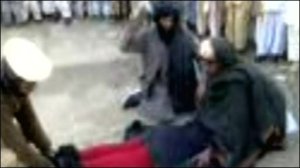
Girl being flogged: Still from the cell phone video circulated on the Internet and broadcast (repeatedly) on the private channels

Girl being flogged: Still from the cell phone video circulated on the Internet and broadcast (repeatedly) on the private channels

The ‘Swat flogging video’ has made headlines all over. Zubeida Mustafa in her excellent article in Dawn today, ‘A catalyst for change? analyses the reasons why

This para jumped out at me: “The Swat flogging video has brought people face to face with the reality of the emergence of extremism in the name of Islam. It has brought to the surface the paradoxes that had until now been swept under the carpet for expediency’s sake. The video has forced difficult choices on the people compelling them to at least think about issues that affect them very personally.”

Zia’s children, by Ayesha Siddiqa in The News, April 05, 2009 highlights the issue of ‘Islamic law’ or ‘Sharia’. She references the recent book by Tahir Wasti ‘Application of Islamic Criminal Law in Pakistan: Sharia in Practice’. Wasti, as she points out, has experience of both Islamic law and British common law. “This is the first detailed research enlisting the ramifications of the application of sharia law in Pakistan. tracing the historical roots of this phenomenon”.

For those who haven’t followed the issue or seen the video (warning, it’s graphic) check out Declan Walsh’s initial report on the issue in The Guardian, April 2, 2009 (two days before TV channels in Pakistan picked it up):

http://tinyurl.com/ck9wf9

Re: my own take – I’ve been swamped with the final editing of another documentary I’m making, but wrote something on the issue the other day that I will share after publication.

Chicago, Shahidul and ‘Three Cups of Tea’

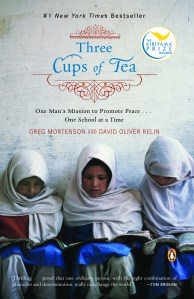
Three Cups of Tea_Mech.indd

Published in Hardnews, New Delhi,April 2, 2009

PERSONAL POLITICAL

Beena Sarwar

I love how connections sometimes just ‘happen’, criss-crossing the world, spanning generations, borders and continents. This particular stream traverses Pakistan’s early progressive struggle to Chicago, an inspiring book by an American who recently received Pakistan’s highest civilian honour, and a Bangladeshi photographer who came to Pakistan to document that moment.

In Chicago for a seminar in May 2007, I stayed with Danial Noorani. He is active with Apna Ghar, a domestic violence shelter for immigrant, primarily South Asian women. His late parents Malik and Mumtaz Noorani were close friends of my parents, active in the Communist Party and city goings-on. Tall jovial Malik Uncle ran a publishing house. ‘Jan-e-Man Phuphi’ (as we called the bright-eyed Mumtaz Noorani because of the endearment she used for us children) was active with Anjuman Jamhooriat Pasand Khawateen (Democratic Women’s Association, headed by Tahira Mazhar Ali, still going strong in Lahore).

There is some symbolism about meeting their son in Chicago. I remembered hearing of Dr Eqbal Ahmad’s disappointment when he found a monument to a policeman rather than the Chicago workers demonstrating for the eight hour day were killed by police fire in 1886. Ironically, the US does not observe May 1 as Labour Day.

Before I left, Danial gave me a paperback titled ‘Three Cups of Tea’ by someone I had vaguely heard of, Greg Mortenson. I couldn’t put it down. It is mandatory reading for anyone interested in education, Pakistan and the ‘war on terror’.

Mortenson builds schools in Pakistan’s remotest areas. The book, co-authored by David Oliver Relin, is sub-titled One Man’s Mission to Promote Peace . . . One School at a Time’– a mission as endangered by the ‘taliban’ as by the militaristic policies of the US and Pakistani governments operating without a political roadmap.

It started in 1993, when Mortenson was recuperating in atiny, unmapped village, Korphe, after being injured while climbing the world’s second highest mountain K2 in the Karakorams. Shocked that the village ‘school’ was a patch of land where children sat in the open scratching their lessons with sticks on the ground, he vowed to build them a school.

Back in the US, he saved rent by sleeping in his car and not taking his girlfriend out to dinner. Not surprisingly, they broke up. Mortenson kept trying to raise funds, manually typing letters to seek help. Two years later he was back at Korphe with a truck-load of building materials.

But he was in for a shock. The villagers told him that they first needed a bridge across the ravine that isolated them. Mortenson nearly went off in a huff. Then he thought about it and realised they were right. An important lesson for aid organizations: ask people what they want and need instead of giving them what you think they should have.

Besides making Korphe more accessible to the world, the bridge enabled the village women to make short trips to visit family on the other side rather than investing days as they used to. And yes, the school was also built. Mortenson has since helped to build some 78 schools in Pakistan (and Afghanistan), providing education to over 28,000 children, including 18,000 girls.

The second part of the book tells a grimmer story: the impact of the mushrooming Wahabi madrassahs and the ‘war on terror’ following ‘9-11’. Mortenson recalls an invitation to the Pentagon to talk about his work, only to realise that they’re not really interested. If they listened to him, perhaps the world would be in less of a mess.

Last August, the Pakistan government announced that Pakistan’s highest civil award, Sitara-e-Pakistan (“Star of Pakistan”) would go to Mortenson for his courage and humanitarian effort to promote education, and literacy in rural areas. The Bangladeshi photographer Shahidul Alam mentioned it when we met last month in Kathmandu. He flew in from Bangladesh especially to record the moment. On March 23rd, 2009, he was in Islamabad with friends of Mortenson watching the awards ceremony live on television.

These are, as Salma Hasan Ali wrote on Shahidul’s blog, “kernels of hope that remind us that all will not be lost to violence and a distorted mindset.”

(ends)