PPC provisions against those inciting violence, hatred, murder

The mindset promoted by the ‘blasphemy’ laws is again highlighted by the recent case of a doctor in Hyderabad arrested for ‘blasphemy’ because he threw the visiting card of a medical representative (Pfizer employee) named Mohammad Faizan into the dustbin.

I have been in correspondence with Asad Jamal, Advocate Lahore High Court, on possible action against those who make false accusations of blasphemy and incite to murder or violence — we were specifically discussing the Maulana who announced a reward of five lakh rupees for killing  Aasiya Noreen, the Christian woman sentenced by a lower court for blasphemy, whose case is going into appeal before the Lahore High Court. (Asad reminded me that in 1995, a similar ‘reward’ (it was then a million rupees, the value has obviously gone down for such murders, given that people are willing to commit them for free) had been offered for killing the minor Salamat Masih. The Lahore High Court acquitted Salamat and his two co-accused but Manzoor Masih, a co-accused in that case, was shot dead outside the court). He writes: Continue reading

Brief update; my Secularism and ‘Blasphemy’ articles & others

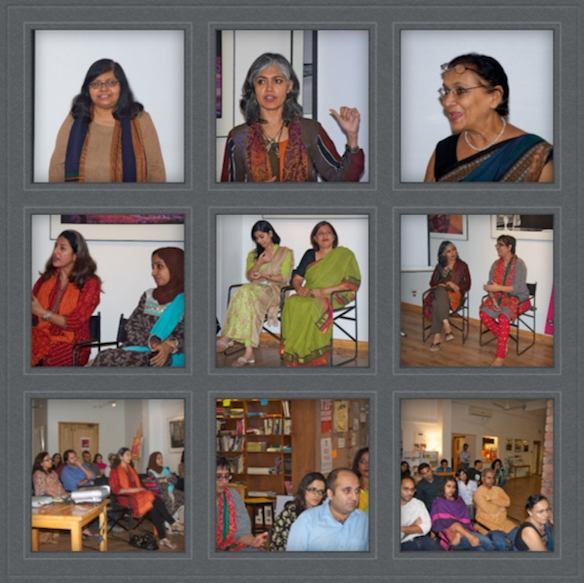
Pix from Take Back the Tech at T2F. Courtesy: Newsline

I posted this to my yahoogroup today, along with a note from Avaaz on taking action against the Wikileaks crackdown (posting that separately)

Links to some of my recent articles, including about the ‘blasphemy law’ and secularism in Pakistan.

A brief update from me: I recently showed the film on DSF (Democratic Students Federation) that Sharjil and I made to a rapt audience in Islamabad at Kuch Khaas, the wonderful space set up by my old friend Poppy (Shayan Afzal Khan) – they hold film screenings, seminars, book launches; hold classes in dance, music etc (with a percentage of the admissions being reserved for underprivileged children who attend on scholarships).

My Mukhtiar Mai film was part of a couple of events held to commemorate 16 Days of Activism against Gender Violence. It was screened at the `No Honour in Killing‘ exhibition curated by Niilofur Farrukh now in Karachi at V.M. Art Gallery till Dec 20th (has been to other cities including Larkana and Jamshoro). It was also part of the Take Back the Tech event linked to 16 Days, at a discussion (Newsline report here) held at The Second Floor in Karachi.

Below, links to my recent articles & others on the ‘blasphemy laws’ and on secularism

BLASPHEMY in Pakistan: time to repeal a flawed law – my OpEd in Common Ground News Service

Also see the other articles on the blasphemy law in Pakistan that I compiled at this link

SECULARISM PAKISTAN: My article “Secularism – Not a dirty word‘ for The News on Sunday’s series on the issue. Shorter version for Hard News, India – my monthly column Personal Political ‘Deep down in our hearts…

Also see the other articles in that series, compiled at this link.

Thanks.

Proposed amendments to the Blasphemy Laws

PPP Parliamentarian Sherry Rehman’s proposed AMENDMENTS TO THE BLASPHEMY LAWS ACT 2010 – posted by Marvi Sirmed at her blog

Aasiya blasphemy case: Field notes, petitions and a press release

The death sentence that a district court handed down to Aasiya Bibi, a poor Christian woman in Punjab, is not the first of its kind except that this is the first time a woman has been so sentenced (but not the first time one has been so accused). Since the ‘blasphemy law’ was promulgated, there have been many such convictions – that the higher courts have always over-turned. District courts have also shown sense: I remember a woman district judge in Karachi acquitting Chand Barkat, a bangle seller who had been accused by a rival). However, vigilante violence (cold-bloodedly orchestrated by extremist organisations) has claimed the lives of some 20 charged under this law or publicly accused of this ‘crime’. Continue reading

Defenders of Internet freedom protest Pakistan facebook ban

Press Release received today:

Karachi, May 20, 2010

Defenders of Internet Freedom Protest Against Nationwide Government Ban of Facebook

On Wednesday 19th May 2010, the Lahore High Court ordered the banning of Facebook across Pakistan. Facebook is the world’s most popular social media network and is used by over 400 million globally. In Pakistan, over 2 million people use Facebook to stay in touch with their friends and family, conduct business, manage events, and share photos, news, and other content. A few days ago, a page called “Everybody Draw Muhammad Day” was created on Facebook asking users to submit drawings of Prophet Muhammad (PBUH) on 20th May 2010. This page, interpreted as blasphemous, has triggered a nationwide ban on the entire Facebook domain.
While we recognize that sites on the Internet are used to spew hatred and incite violence, we steadfastly believe that governments have no right to control access to information. We believe that every citizen has an inalienable right to freely access information and by censoring Facebook, the Government of Pakistan has taken away that right. This action will have a very negative impact on Pakistan, especially considering that countless small businesses, nonprofit organizations, restaurants, art galleries, magazines, and media outlets use Facebook to conduct day-to-day business and share information with their stakeholders.
In 2006, the Supreme Court of Pakistan banned the entire blogspot.com domain for over 18 months over a similar incident where only one blog carried blasphemous cartoons. Thousands of Pakistani bloggers were deprived of the freedom to express themselves and interact with others. The Pakistan Telecommunication Authority now has the ability to block specific pages on the Internet and could have banned just the single blasphemous page. As members of civil society and professionals who depend on social media networks for our daily communications, we demand the immediate restoration of Facebook and an end to Internet censorship by the Government of Pakistan.
Press conference to discuss the worrying trend of Internet censorship and the resulting impact on civil liberties and the free and unfettered exchange of ideas and information, today, 5:00 pm,Karachi Press Club

‘Blasphemy laws’ – Stopping the rot

My recent article on the ‘blasphemy’ laws, slightly edited version published in Dawn, Aug 29, op-ed as  ‘A misguided mindset’ – http://tinyurl.com/lzx6ux

Karachi, Aug 26

Stopping the rot

Beena Sarwar

The introspection, debate and outrage generated a month ago by the attacks on two villages in Gojra on July 31 and Aug 1 may be out of public sight, as happened all too often in the past, but the nine people murdered and the homes and churches gutted are not out of mind. Neither is Najeeb Zafar, the young factory owner in Sheikhupura, Punjab, killed on August 4 for allegedly desecrating Quranic verses when he removed a calendar from a wall. The following day, police in Sanghar, Sindh, saved a similarly accused 60-year old woman, Akhtari Malkani by taking her in protective custody.

On the surface, these incidents were motivated by passions aroused by allegations of blasphemy or disrespect to the holy Quran. These criminal charges can be punishable by death – but this is a punishment for the state to administer, not private citizens. The real motivation remains settling scores, a pattern identified over twenty years ago when the first ‘blasphemy murder’ took place – that of the Punjabi poet and teacher Naiamat Ahmar in Faisalabad in 1992.

The pattern involves one party targeting another, alleging blasphemy while the real motives are personal enmity or economic rivalry as Zubeida Mustafa noted in a recent column. The accused tend to be poor people who have improved their lot in life, triggering jealousies. Accusations of blasphemy are used to justify the violence. Ms Mustafa also pointed to (mis) education as a factor that makes it easy, when such an allegation is levelled, to rabble-rouse a mob into violence.

The three recent cases bear out these observations. In Gojra, evidence points to a pre-meditated plan aimed at clearing out the village from the area, while the administration turned a deaf ear to the warnings and pleas of observers. A disgruntled employee accused Najeeb Zafar of disrespecting the Quran; the unarmed police sent to protect him could only watch as the mob set upon him. Akhtari Malkani had a monetary dispute with her accuser – he disappeared without registering an FIR. She says she threw a book of accounts on the floor, not the holy Quran.

Last April, there was the horrific case of Jagdish Kumar, the young Hindu factory worker in Karachi, lynched by co-workers for alleged blasphemy. The real reason appears to have been personal enmity based on Kumar’s reported association with a Muslim girl.

Such cases have been taking place since the option of life imprisonment under Section 295-C of the Pakistan Penal Code (“Use of derogatory remarks, etc., in respect of the Holy Prophet”), the ‘blasphemy law’, introduced by Gen. Ziaul Haq in 1985 was amended by default in 1992 to make death the mandatory punishment for anyone convicted under this law. Certainly, the law does not provide for these extra-judicial murders. However, it is equally true no such murder took place until death was made the mandatory punishment for 295-C convictions.

People of all faiths, including Muslims (remember the Muslim religious scholar lynched in Gujranwala, 1994?), have been accused and attacked since then. Investigations into blasphemy accusations indicate pre-meditation rather than the heat of passion. Those who commit the violence may be arrested but none has ever been punished. Even the Inquiry Commission Tribunal headed by Justice Tanvir A. Khan of the Lahore High Court examining the destruction of Christian homes and churches in Shantinagar, 1997, was quashed (the Punjab Chief Minister then too was Shahbaz Sharif; will he rise to the occasion this time?).

The public defamation of blasphemy victims is a key tactic preceding such attacks – posters and mosque loudspeakers are routinely used for this.

Naimat Ahmar was killed after posters cropped up warning people that a Christian teacher (Ahmar) was leading their children astray. A hand-written copy in Urdu that I saw at the time warned Muslims that Ahmar was misleading students, telling them that the Prophet (pbuh) ‘stole’ goats – ‘bakriyaN charaya kartey thay’. Replace ‘churaya’ (stole) with ‘charaya’ (grazed) and it’s apparent what Ahmar probably said.

A youngster from the militant outfit Anjuman-e-Sipah-e-Sahaba (later changed to Sipah-e-Sahaba Pakistan) accosted Ahmar outside the Education Department in Faisalabad and knifed him to death. Investigations revealed that the murderer’s uncle wanted Ahmar’s job in the Education Department. The allegation of blasphemy alone was enough to ‘justify’ the murder. Policemen at the lockup housing the murderer, garlanded by his ASS (sic) mentors, embraced and kissed him. The ASS was, in fact, behind just about every ‘blasphemy case’ during the 1990s – the SSP, now banned, is believed to be behind the Gojra carnage as well.

Blasphemy accused are attacked and murdered even in prisons and police lock-ups, sometimes by the very people who are supposed to protect them. In 2004 a police constable attacked Samuel Masih, 27, an under-trial prisoner at Kot Lakhpat jail with a brick-cutter. Samuel had been charged with spitting at the wall of a mosque (Section 295, “defiling a place of worship with the intent of insulting the religion of any class”, maximum sentence up to two years). He succumbed to his injuries the following day. “I wanted to earn a place in heaven by killing him,” Ali reportedly confessed.

The fanatical and misguided mindset cultivated over the past few decades will not disappear by simply repealing 295-C, although this must be done. Embarking on a sensible education policy is also a long-term step that must be taken to stop the rot. What must be an immediate priority is the strict enforcement of law and order.

Those inciting violence and murder from mosque loudspeakers and public accusations, true or false, must be held culpable, charged, tried and punished according to law. This also goes for those who desecrate a holy book or symbol of any religion. There must be accountability for those who allow these murders to take place. The political leadership is responsible for providing police with the training, means and the orders to prevent such violence. Finally, religion cannot be used or allowed to justify murder.

The writer is a freelance journalist and documentary filmmaker

(ends)

Naeem Sadiq, Gojra and the Zakat suo moto notice

Aug 14 food for thought – it’s not just about Gojra as Shi’ias, Ahmedis and other endangered citizens of Pakistan deemed minorities by the religious extremists will testify. Posted below is Naeem Sadiq’s note of Aug 14 & my comment. Also below update on Naeem’s petition currently being heard by the Supreme Court, adjudicating on whether individual citizens are bound by the sharia version of state or not.

Incidentally, one small positive step is that the religion section on the new computerised Pakistani passports has been quietly done away with, so that they no longer contain a declaration of the bearer’s religion. However, Muslim applicants are still required to abuse Mirza Ghulam Ahmed, the spiritual leader of the Ahmedis whom the Parliament declared as non-Muslims during the Bhutto era. It’s a long and uphill battle — one that we cannot afford to lose.

Over to Naeem Sadiq, the indefatigable campaigner on Aug 14  — he agrees of course that Shi’as in Parachinar, DI Khan, Hangu, Quetta have for years now been subject to seige, murder, forced migration, ignored by the media or government – not to take anything away from the victims of Gojra… but food for thought:

From Naeem Sadiq, 14th  August

I decided not to celebrate the 14th August this year, to record my personal grief, shame and solidarity with the innocent citizens of Gojra, who were killed , wounded and burnt, for belonging to the same God, but a different religion. In my room I will fly the Pakistan flag at half mast, I will put my TV off,  have none of those “milli naghmey”  and sing no national anthem.  I am sad, ashamed and distressed. I will call up all my Christian friends to say I am deeply sorry and I apologise.

I do not wish to celebrate the birthdays of a land where the Mullahs spread hate from the minarets of their mosques.  Where 20,000 Muslims unite to kill a few hundred   Christian men, women and children.  Where the administration provides bullet proof vehicles and multi layer protection to its leaders but will do nothing to protect the  life and property of its  ordinary citizens.  I am ashamed that not one person, the CM, the PM, the Governor or the President resigned from his  job as an admission of failure to perform their primary duty.

There are plenty of  flags, parades, speeches and ceremonies, but  no real sense of guilt, remorse,  or reform. The Dawn newspaper alone has 24 ‘ad’ nauseam ads, sponsored by the government departments, with the tax payers’ money, most carrying the pictures of four members of the same family.  All under the garb of a “Happy Birthday to you, dear Pakistan”.   The theft and plunder of peoples’  money  does not pause for rest, even on the 14th day of August.  Should  not a state, at a minimum,  protect the life and property of all its citizens,  to deserve ‘a happy birthday’.

PLUS: UPDATE ON THE SUO MOTO CASE REGARDING THE ISSUE OF COMPULSORY DEDUCTION OF ZAKAT BY BANKS, HEARD BY THE SC ON AUG 10, 2009. (SUO MOTO case no.12 of 2009).

Please note: THIS MATTER IS CURRENTLY SUB-JUDICE. PLEASE MAKE  NO COMMENTS  THAT MAY INFLUENCE THE PROCEEDINGS IN ANY MANNER.  THANKS. ns

The Supreme Court took SUO Moto notice on the appeal of an ordinary citizen, and a  panel of three SC judges, headed by the chief Justice of Pakistan heard the case at 1300 hrs on August 10, 2009 .

Two issues were raised.

a.  That the procedure  for exemption from compulsory deduction of Zakat (notary public, two witnesses, affidavits , stamp paper, CZ-50 etc) was tedious, time wasting , and cumbersome for ordinary citizens

b. The  state cannot compel its citizens to declare a specific “Fiqh”, and thus be divided and boxed into one or the other schools of interpretations.

The Hon’able SC judges heard the submission, agreed that it was a pro bono case and ordered the State Bank and the Federation of Pakistan to appear before the court  in the next hearing, and explain why this procedure can not be simplified and improved in the light of issues raised by the appellant.

The next hearing was fixed for 1st week of October.

Background: Naeem Sadiq had approached the SC to take suo moto notice on the issue of compulsory deduction of Zakat by banks. The CJ accepted the  application and ordered  the case be heard at 0930 hrs on 10 August 2009 at Islamabad Supreme Court.  Required to appear in person.

The original letter that was sent to SC:

An appeal to the Supreme Court of Pakistan

For a  public interest Suo moto notice

Honourable Chief Justice,

The Supreme Court of Pakistan in a landmark judgment on March 9, 1999 gave a ruling that members of all ‘Fiqhs’ were entitled to exemption from compulsory deduction of  Zakat, and the Federal Government had no authority to reject the declaration of any Muslim seeking exemption from Zakat, if it was made on a prescribed form. This judgment enables any Muslim to declare his / her  ‘Fiqh” and thus seek exemption from compulsory deduction of Zakat. Defacto it also recognizes the right of individuals to practice their faith according to their own fiqhs, and not be dictated by the government’s interpretation.

The historic judgment while so well recognizing the right of individuals in matters of their faith, made an irritating mess on how this right was to be practiced. Firstly it requires Muslims to declare their “Fiqh”. The great Prophet of Islam did not subscribe to any  ‘sect’ or ‘fiqh’. For his followers to be forced  to invent, be branded and be divided by sects and ‘fiqhs’ is therefore an absolutely  unethical and undesirable  demand on the part of the government.

The second irritant relates to the requirement of making this declaration on a  prescribed format, thus creating a  serious bureaucratic and procedural difficulty for the ordinary citizens. They are  required to fill a judicial stamped paper of Rs.20 (available for Rs.120), have it signed by a notary public and two witnesses before making a completely unnecessary declaration  of their ‘fiqh’. The form is also called CZ-50 affidavit.

This anomaly could be easily rectified if the Supreme Court through a public interest suo moto notice, clarify  its original judgment by requiring only those Muslims to give in writing (on a plain piece of paper) who do wish their Zakat to be deducted by a bank. This would truly be in keeping with the  SC verdict that all Muslims are entitled to exemption from compulsory deduction of Zakat.

Naeem Sadiq

Karachi

Simply repealing 295-C will not stop the rot

Since it was introduced by Gen. Zia, the ‘blasphemy law’ 295-C has been used to settle scores, including financial rivalries, as umpteen fact-finding missions have recorded (included several I have participated in), much as the Zina laws have been used for revenge.

Now, simply repealing 295-C will not stop the rot. That must be done, but along with it we have to demand strict enforcement of law and order.

Those who incite violence and murder (eg mullahs who used loudspeakers) must be held culpable as well, charged, tried and punished in accordance with the law.

Ditto those who desecrate a holy book or symbol, no matter of what religion.

Below, links to some reports that provide a perspective on the issue:

PAKISTANI CHRISTIANS-THE VICTIMS OF HALF LAW IN GOJRA, by Brigadier Samson Simon Sharaf (Retired), Aug 5, 2009

http://chowk.com/ilogs/73055/47736

An Eyewitness Account from Gojra – Faris Kasim.  August 7, 2009

http://www.chowk.com/articles/an-eyewitness-account-from-gojra-faris-kasim.htm

Edited version in The News Op-Ed, Aug 8, 2009

http://www.thenews.com.pk/daily_detail.asp?id=191978

HRCP press releases, Aug 4 & Aug 1
http://hrcpblog.wordpress.com/2009/08/06/gojra-admin-knew-about-pre-planned-attacks-hrcp/

http://hrcpblog.wordpress.com/2009/08/06/hrcp-press-release-on-gojra-and-korian-incident/

Lethal Law, Newsline Sept 2001
http://www.newsline.com.pk/NewsSept2001/newsbeat.htm