

First, the good news.
Our Pulitzer Center-supported documentary ‘Democracy in Debt: SriLanka Beyond the Headlines’ has just been selected by the Pune Short Film Festival 2025, June 2. It has also been selected for the Asian Talent International Film Fest 2025, Oct. 5, in Ahmednagar, Maharashtra, and was earlier screened at the Fifth Kerala Short Film Festival 2025, held in March.
Here’s the trailer. To watch the film, fill in the Global Community Screening form linked here.
More good news
Our peace appeal for India and Pakistan to Stop Hostilities posted by the Southasia Peace Action Network or Sapan just after the war broke out reached more than 5,000 signatures in the first 48 hours. It had reached nearly 7,500 signatories but the number inexplicably dropped so now we are just over 7,000. In this vitiated atmosphere where jingoism dominates the airwaves and social media, this is no small number. Let’s keep on the pressure for these two nuclear-powered neighbours to talk.
The sad news
DW News in Germany ran a moving report on Pakistani children barred from medical treatment in India – the human cost of these hostilities. They ran the report just before the interviewer came to me, and I found it hard to gather myself to respond. In the recording uploaded to YouTube, shared below, Harsh Mander, the inspiring and courageous Indian peace activist and humanist, speaks just before me.
On another note, it is good to see that the brand name Aman Ki Asha (‘hope for peace’) lives on. I continue to occasionally update the website amankiasha.com — the two media houses which started the initiative never officially closed it down.
The “hope for peace” will continue, with so many Peacemongers across all kinds of borders – country, region, age, ethnicity, class, caste, race, religion — continuing to work for peace.
What does ‘peace’ mean to young Southasians?
Find out at this special virtual discussion on Sunday, May 25, bringing together Southasians, age 16-25, from across the region. With rising hostilities threatening to eclipse empathy, this intergenerational dialogue is a timely intervention that centres the voices and visions of those who will inherit the region.
‘How does the world view the India Pakistan ceasefire?’
I was on Rajdeep Sardesai’s show last weekend, along with ex-CIA officer Derek Grossman, Senior Defense Analyst, RAND in California; Gil Barndollar, non-resident fellow, Defense Priorities and former officer, United States Marine Corps, Washington D.C.; Einar Tangen, a Korean American political and economic affairs commentator in Beijing; and Leela K Ponappa, retired Indian diplomat, former Deputy National Security Adviser and Secretary and National Security Council Secretariat.
Guess whose views I found most reasonable?
‘Southasia is One Word’
I’m thrilled that the writer Zachary L. Zavidé chose to title his excellent report on Dr. Pervez Hoodbhoy’s meetup with students at MIT earlier this week as ‘Southasia is One Word’ which he took from our Sapan note: “*Why Southasia as one word? Because history, geography and shared struggles say so” — nicely expressed by Sapan News Associate Editor Pragyan Srivastava who has a way with words.
The origin of this term comes of course from senior journalist and democracy activist Kanak Mani Dixit in Kathmandu, who made it part of the style of the groundbreaking Himal Southasian magazine, that he launched in 1997 – I was on the founding editorial board, along with journalists Mitu Varma, Nalaka Gunawardene, Afsan Chowdhury and others. Our relationships continue to strengthen the Southasia Peace Action Network.
Healing intergenerational trauma
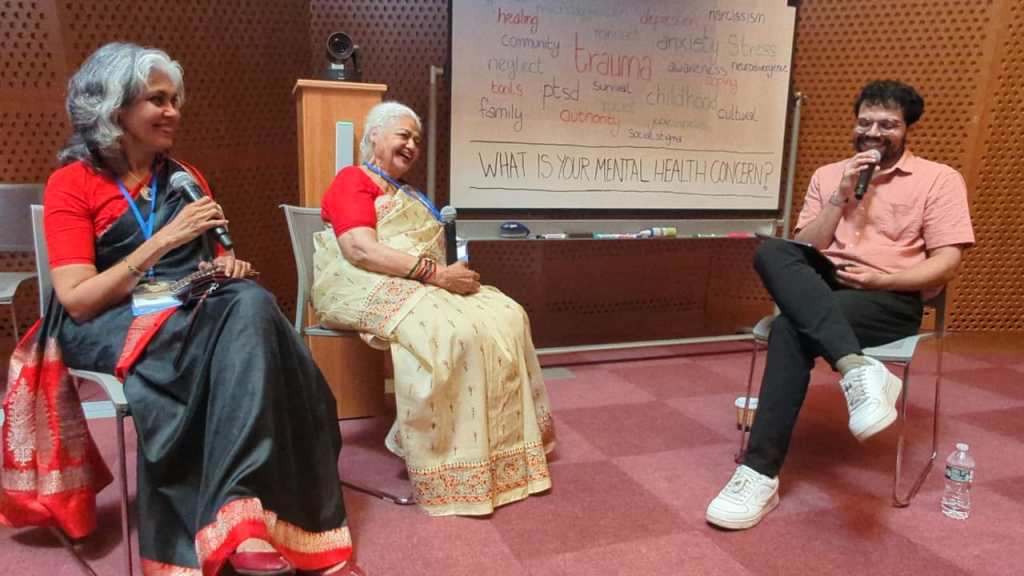
Don’t miss Pragyan’s great report on a groundbreaking seminar at MIT a couple of weeks ago, on breaking the cycle of intergenerational trauma, organised by SAPNA, the newly formed South Asian Psychology and Neuroscience Association. The founders are Imran Sayeed, a prominent Pakistan-origin entrepreneur and educator in the Boston area, and Neha Katyal, an Indian-origin pharmacist and product manager in health tech. Another example of the kind of collaborations that happen when we meet.
My mother Prof. Zakia Sarwar and I were on a panel together at the conference. It was a learning experience for both of us, pushing us to reflect on areas we don’t usually think about.
Thanks for reading.
Filed under: Kashmir, Pakistan-India | Tagged: democracy, freedom, Politics, revolution |


 Journeys to democracy
Leave a comment