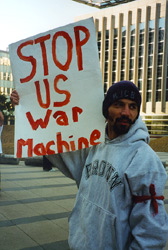
Emmanuel Ortiz protests in front of the Minneapolis Federal Building against the U.S. bombing of Sudan and Afghanistan - August 21, 1998
1. A must read: Tomgram: Rebecca Solnit, 9/11’s Living Monuments
http://www.tomdispatch.com/ (thanks Dr Ehtisham)
2. I remember reading this powerful poem before; thanks to Shahzad Nazir Khan
for posting it again
Photo from: Faces of Resistance
A MOMENT OF SILENCE, BEFORE I START THIS POEM
By EMMANUEL ORTIZ, 11 Sep 2002
Before I start this poem,
I’d like to ask you to join me
In a moment of silence
In honor of those who died in the World Trade Center and the
Pentagon last September 11th.
I would also like to ask you
To offer up a moment of silence
For all of those who have been harassed, imprisoned,
disappeared, tortured, raped, or killed in retaliation for those strikes
For the victims in both Afghanistan and the U.S.
And if I could just add one more thing…
A full day of silence
For the tens of thousands of Palestinians who have died at the
hands of U.S.-backed Israeli
forces over decades of occupation.
Six months of silence for the million and-a-half Iraqi people,
mostly children, who have died of
malnourishment or starvation as a result of an 11-year U.S.
embargo against the country.
Before I begin this poem,
Two months of silence for the Blacks under Apartheid in South Africa,
Where homeland security made them aliens in their own country.
Nine months of silence for the dead in Hiroshima and Nagasaki,
Where death rained down and peeled back every layer of
concrete, steel, earth and skin
And the survivors went on as if alive.
A year of silence for the millions of dead in Vietnam – a people,
not a war – for those who
know a thing or two about the scent of burning fuel, their
relatives’ bones buried in it, their babies born of it.
A year of silence for the dead in Cambodia and Laos, victims of
a secret war … ssssshhhhhhh…
Say nothing
we don’t want them to learn that they are dead.
Two months of silence for the decades of dead in Colombia,
Whose names, like the corpses they once represented,
have piled up and slipped off our tongues.
Before I begin this poem.
An hour of silence for El Salvador …
An afternoon of silence for Nicaragua …
Two days of silence for the Guatemaltecos …
None of whom ever knew a moment of peace in their living years.
45 seconds of silence for the 45 dead at Acteal, Chiapas
25 years of silence for the hundred million Africans who found
their graves far deeper in the ocean than any building could
poke into the sky.
There will be no DNA testing or dental records to identify their remains.
And for those who were strung and swung from the heights of
sycamore trees in the south, the north, the east, and the west…
100 years of silence…
For the hundreds of millions of Indigenous peoples from this half
of right here,
Whose land and lives were stolen,
In postcard-perfect plots like Pine Ridge, Wounded Knee, Sand Creek,
Fallen Timbers, or the Trail of Tears.
Names now reduced to innocuous magnetic poetry on the
refrigerator of our consciousness …
So you want a moment of silence?
And we are all left speechless
Our tongues snatched from our mouths
Our eyes stapled shut
A moment of silence
And the poets have all been laid to rest
The drums disintegrating into dust.
Before I begin this poem,
You want a moment of silence
You mourn now as if the world will never be the same
And the rest of us hope to hell it won’t be.
Not like it always has
been.
Because this is not a 9/11 poem.
This is a 9/10 poem,
It is a 9/9 poem,
A 9/8 poem,
A 9/7 poem
This is a 1492 poem.
This is a poem about what causes poems like this to be written.
And if this is a 9/11 poem, then:
This is a September 11th poem for Chile, 1971.
This is a September 12th poem for Steven Biko in South Africa, 1977.
This is a September 13th poem for the brothers at Attica Prison, New York, 1971.
This is a September 14th poem for Somalia, 1992.
This is a poem for every date that falls to the ground in ashes
This is a poem for the 110 stories that were never told
The 110 stories that history chose not to write in textbooks
The 110 stories that CNN, BBC, The New York Times, and Newsweek ignored.
This is a poem for interrupting this program.
And still you want a moment of silence for your dead?
We could give you lifetimes of empty:
The unmarked graves
The lost languages
The uprooted trees and histories
The dead stares on the faces of nameless children
Before I start this poem we could be silent forever
Or just long enough to hunger,
For the dust to bury us
And you would still ask us
For more of our silence.
If you want a moment of silence
Then stop the oil pumps
Turn off the engines and the televisions
Sink the cruise ships
Crash the stock markets
Unplug the marquee lights,
Delete the instant messages,
Derail the trains, the light rail transit.
If you want a moment of silence, put a brick through the window of Taco Bell,
And pay the workers for wages lost.
Tear down the liquor stores,
The townhouses, the White Houses, the jailhouses, the
Penthouses and the Playboys.
If you want a moment of silence,
Then take it
On Super Bowl Sunday,
The Fourth of July
During Dayton’s 13 hour sale
Or the next time your white guilt fills the room where my beautiful
people have gathered.
You want a moment of silence
Then take it NOW,
Before this poem begins.
Here, in the echo of my voice,
In the pause between goosesteps of the second hand,
In the space between bodies in embrace,
Here is your silence,
Take it.
But take it all…
Don’t cut in line.
Let your silence begin at the beginning of crime.
But we,
Tonight we will keep right on singing
For our dead.
Emmanuel Ortiz is a third-generation Chicano/Puerto Rican/Irish-American community organizer and spoken word poet residing in Minneapolis, MN. He currently serves on the board of directors for the Minnesota Spoken Word Association, and is the coordinator of Guerrilla Wordfare, a Twin Cities-based grassroots project bringing together artists of color to address socio-political issues and raise funds for progressive organizing in communities of color through art as a tool of social change.
(Note: This is the information that came with the posting I received – have been unable to find any more information on Ortiz; if anyone knows more eg a website or blog, pls do let me know. thanks)
Filed under: 'War on terror' | Tagged: 9/11, Allende, Attica prison New York, Chile, Emmanuel Ortiz, Israeli occupation, Palestine, Rebecca Solnit, Somalia, Steve Biko, Tom Engelhardt | Leave a comment »






 Journeys to democracy