

A message from the journalist Amitabh Pal about a mutual friend, David Barsamian of Alternative Radio in Colorado reminded me of this piece originally published in The News on Sunday, 8 Oct. 2006, about an event with Noam Chomsky where I first met David. The article is still all-too relevant, but the link no longer works so I’m sharing the piece here without any changes; just added some hyperlinks and photos.
Essential reading – and doing: Eqbal Ahmad
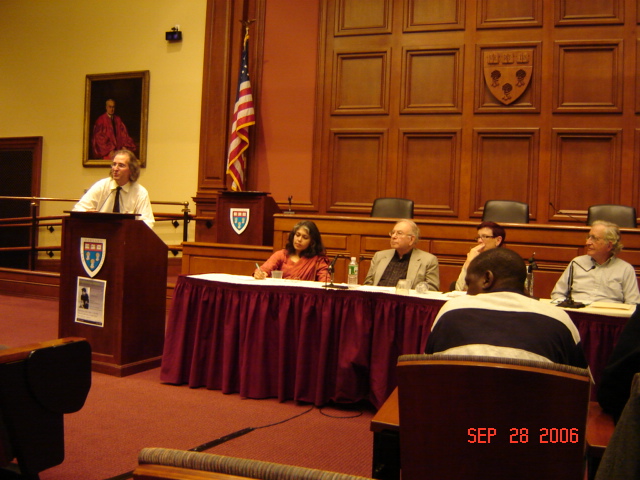
Book launch: The Selected Writings of Eqbal Ahmad, Cambridge, September 28, 2006.
Beena Sarwar
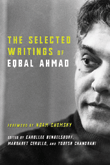
When Venezuelan president Hugo Chavez in his address to the UN on Sept 20, held up a copy of Noam Chomsky’s Hegemony or Survival: America’s Quest for Global Dominance (2003) and recommended it as essential reading to understand contemporary world politics, he could have been talking about The Selected Writings of Eqbal Ahmad, for which Chomsky, Eqbal’s long-time friend, wrote the foreword. Chavez identified “the hegemonic pretension of the North American imperialism” as “the greatest threat on this planet” to the survival of the human race.
Chomsky also gave the main address for this collection of Eqbal Ahmad’s writings (Columbia University Press, 2006) at the book’s launch in Cambridge, USA, on September 28. John Trumpbour and Emran Qureshi of the Labor & Worklife Program at the Harvard Law School, who organised the event, didn’t publicise the event too aggressively because of the hype Chavez had generated for Chomsky.
The hall did get quite full, but they didn’t have to turn anyone away at the door. The venue may have had something to do with this. Chomsky, a linguistics professor now retired from the neighbouring MIT, is rarely invited to Harvard. Harvard Law School professor Alan Dershowtiz criticises Chomsky for being too “black and white” but often has to concede the basic truth of the points Chomsky makes.
Continue readingFiled under: 'War on terror', History, Media, Pakistan, Progressive politics, Resistance, Southasia, Terrorism, Violence in the name of religion | Tagged: Ahmadis, Bhutto, Boston Globe, David Barsamian, El Salvador, eqbal ahmad, Faiz, Gen Zia, Ghalib, Hampshire College, Harvard law school, Hegemony or Survival book, Hezbollah, history, Hugo Chavez, Ibne Khaldun, India, Iraq war, israeli aggression, Jinnah, John Negroponte, Labor & Worklife Program, Lebanon, lied to Congress, logic of counter-insurgency, Margaret Cerullo, Morocco, noam chomsky, nuclear tests, Pakistan, Palestinian brothers held, poetry, Princeton University, Salvadoran option, stuart schaar, Talibanisation, US support for israel | Leave a comment »


 Journeys to democracy