“TO BE HOPEFUL in bad times is not just foolishly romantic. It is based on the fact that human history is a history not only of cruelty, but also of compassion, sacrifice, courage, and kindness. What we choose to emphasize in this complex history will determine our lives. If we see only the worst, it destroys our capacity to do something. If we remember those times and places — and there are so many — where people have behaved magnificently, this gives us the energy to act, and at least the possibility of sending this spinning top of a world in a different direction. And if we do act, in however small a way, we don’t have to wait for some grand utopian future. The future is an infinite succession of presents, and to live now as we think human beings should live, in defiance of all that is bad around us, is itself a marvelous victory.” ― Howard Zinn
This quote at the end of an email from the great broadcaster David Barsamian of Alternative Radio is from Howard Zinn’s collection of essays published in, ‘A Power Governments Cannot Suppress’(City Lights Books, 2007) and also published on ZNet as “The Optimism of Uncertainty.”.
Thought to share here. Salute, Howard Zinn. Salute, David ji. And revisiting my precious meeting with Howard Zinn in Cambridge MA some years ago, thanks to the wonderful filmmaker B.J. Bullert in Seattle WA.
As news of Noam Chomsky’s failing health makes the rounds, I share some learnings from my interactions with a trailblazing public intellectual whose moral compass has impacted the world
PERSONAL POLITICAL By Beena Sarwar
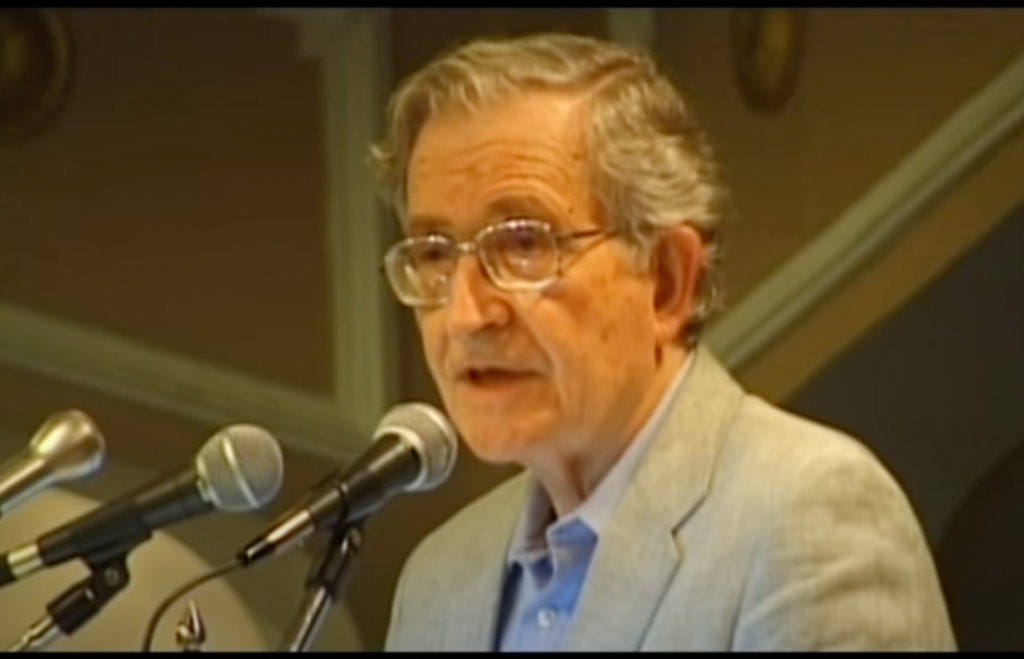
Noam Chomsky in Pakistan, 2001. Screenshot from VPRO news report by Beena Sarwar.
I once asked Noam Chomsky how he manages to remember so many facts and figures and hold audience attention. He replied that he didn’t convey any new information, that his talks are based on materials already in the public domain, and that he simply joins the dots – providing context – and repeats the information consistently and in different ways.
His response was typical of his humility as well as his courtesy towards a much younger person to whom he owed nothing.
Chomsky teaches us that it is not necessary to be loud and sensationalist in order to be heard. This, together with the clear and courageous moral compass he has provided over decades, is a most valuable lesson.
Noam Chomsky was already a legend when I first met him over two decades ago in December 2001 when he visited Pakistan for the inaugural Eqbal Ahmad Memorial lecture series.
We need to refute the idea that our nation is different from, morally superior to, the other imperial powers of world history.
We need to assert our allegiance to the human race, and not to any one nation.
From progressive.org, forwarded by Isa Daudpota. So relevant not just to USA and the time it was written, but today and elsewhere too.
Howard Zinn’s July 4th Wisdom
4-5 min read
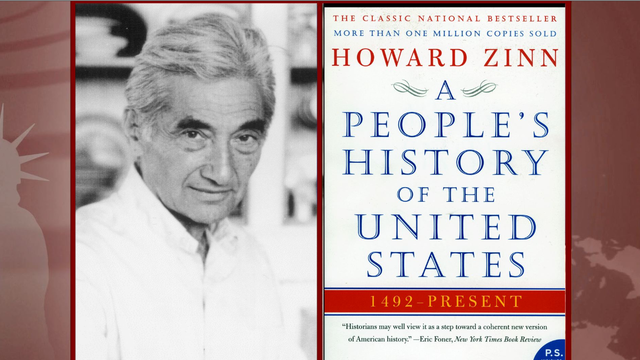
Editor’s Note: The late historian and Progressive columnist Howard Zinn shared these words with us back in 2006. His message is still just as compelling A World War II bombardier, Zinn was the author of the best-selling book A People’s History of the United States.
On this July 4, we would do well to renounce nationalism and all its symbols: its flags, its pledges of allegiance, its anthems, its insistence in song that God must single out America to be blessed.
Is not nationalism—that devotion to a flag, an anthem, a boundary so fierce it engenders mass murder—one of the great evils of our time, along with racism, along with religious hatred?
These ways of thinking—cultivated, nurtured, indoctrinated from childhood on— have been useful to those in power, and deadly for those out of power.
He’s not shouting or holding up placards. Just sitting atop a green box by the Park Street Station at Boston Common, hands clasped around knees drawn up to his body. Wearing a bicycle helmet, purple rimmed reflector sunglasses, black t-shirt and shorts, sneakers.
“Stop racism,” he says to no one in particular.
I turn back to talk to him, and later notice the posters on the wall a few feet away from where he’s sitting. Fight for Socialism. Rent Control. Fight Fascism. Continue reading →
The Zinn magic. Photo: BJ Bullert, Cambridge MA, 2006
“To be hopeful in bad times is not just foolishly romantic. It is based on the fact that human history is a history not only of a cruelty but also of compassion, sacrifice, courage, kindness”
– Howard Zinn
Howard Zinn’s death on Jan 27 came as a shock to his friends and admirers around the world. The iconic historian, activist, and academic (Professor Emeritus, Boston University) was 87, frail, but in reasonable health. He had a heart attack while swimming, an activity he loved. As Arundhati Roy put it when she called his old friend David Barsamian of Alternative Radio: “Howard lived a glorious life and accomplished so much and to die swimming — what a way to go”.
Howard Zinn, Cambridge, Oct 2006 (photo: BJ Bullert)
David writes that Howard had rented a place with a swimming pool near the ocean for three weeks and “was thrilled to be escaping the dreaded Boston winter.”
A fluent Urdu/Hindi speaker, David sent this note to friends: “A light has gone out. There are new lights to be lit,” adding the following verse from Iqbal’s poetry:
Sitaron se aage jahan aur bhi hain abhi ishq ke imtehan aur bhi (Beyond these stars there are other galaxies The real test of love is yet to come)
In November when he visited Howard David noticed a mug in his kitchen with these words: ‘Sooner or later the American people are going to wake up’ – Emma Goldman, Detroit 26 Nov 1919. “
The book that Jack launched (at HLS)
It was going to be my lead question to him in the interview we were going to do,” wrote David. “I was to have left here on Thurs to join him.” (Howard died on Wednesday).
David sent a link to his radio tribute to Howard adding, “Please listen and of course feel free to distribute. It’s about 30 minutes.” His note ended rousingly: “Onward/Adelante/Howard Zinn Presente!”
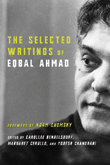
We had been in email contact for some time but I met David for the first time at the launch of Eqbal Ahmad’s collected essays published posthumously by Columbia University Press in September 2006. The launch took place subversively at Harvard Law School – subversively because HLS is a rather conservative place where the views of people like Eqbal Ahmad and his friends and comrades – David Barsamian, Howard Zinn, Noam Chomsky to name some – are rarely heard (particularly in the context of the Middle East, Palestine, Israel). But some pockets of resistance exist in those gilded halls. They include John Trumpbour (Jack), Research Director at Labor & Worklife Program, Harvard Law School.
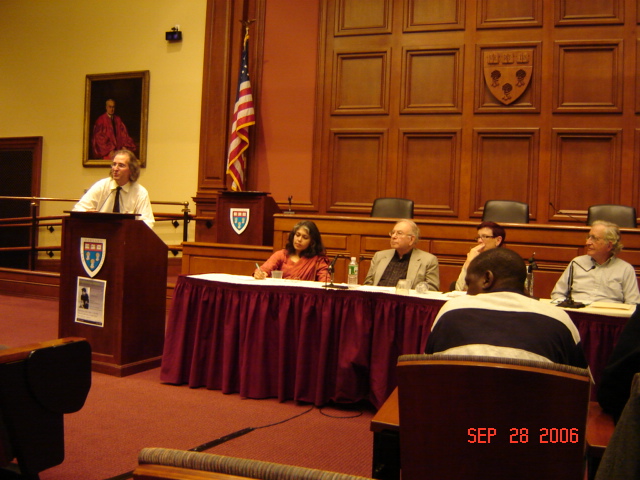
Jack introducing the Eqbal Ahmad book launch and panelists. R-L – Chomsky, Margaret Cerullo, Stuart Schaar & me.
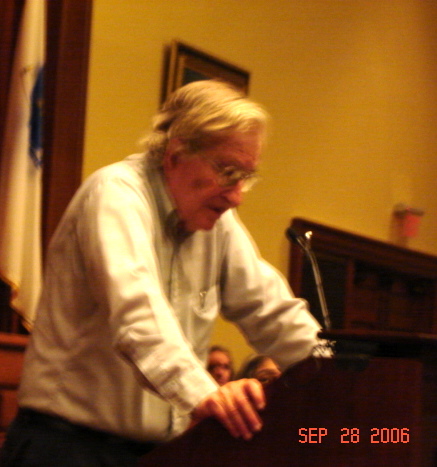
Jack, who organised the launch, invited me to be on the panel (I was then a fellow at the Carr Center for Human Rights Policy, Kennedy School). David flew in from Colorado for the launch. Noam Chomsky, a long-time friend of Eqbal’s, gave the main speech. (I sent my report on the event reproduced at Pakistaniat to Howard – he replied: “That’s a lovely story, with wonderful photos!”)
There was pin drop silence as Chomsky spoke in his characteristic low key way.
Chomsky was of course also an old friend of Howard Zinn’s. In an email responding to my note of condolence he wrote: “It is a sad moment, not just personally, but for wide circles far beyond his family and many friends. A really remarkable person, just as you say, as well as a close personal friend for many years.”
Jack recalls his last meeting with Howard, whom he had invited to teach at a class at the Harvard Trade Union Program in January, just a couple of weeks earlier. “Howard had lost some significant weight in the last year, but he was energetic and engaging as always. He showed a lot of clips from the new history movie he helped make, including appearances by Bob Dylan and Bruce Springsteen.”
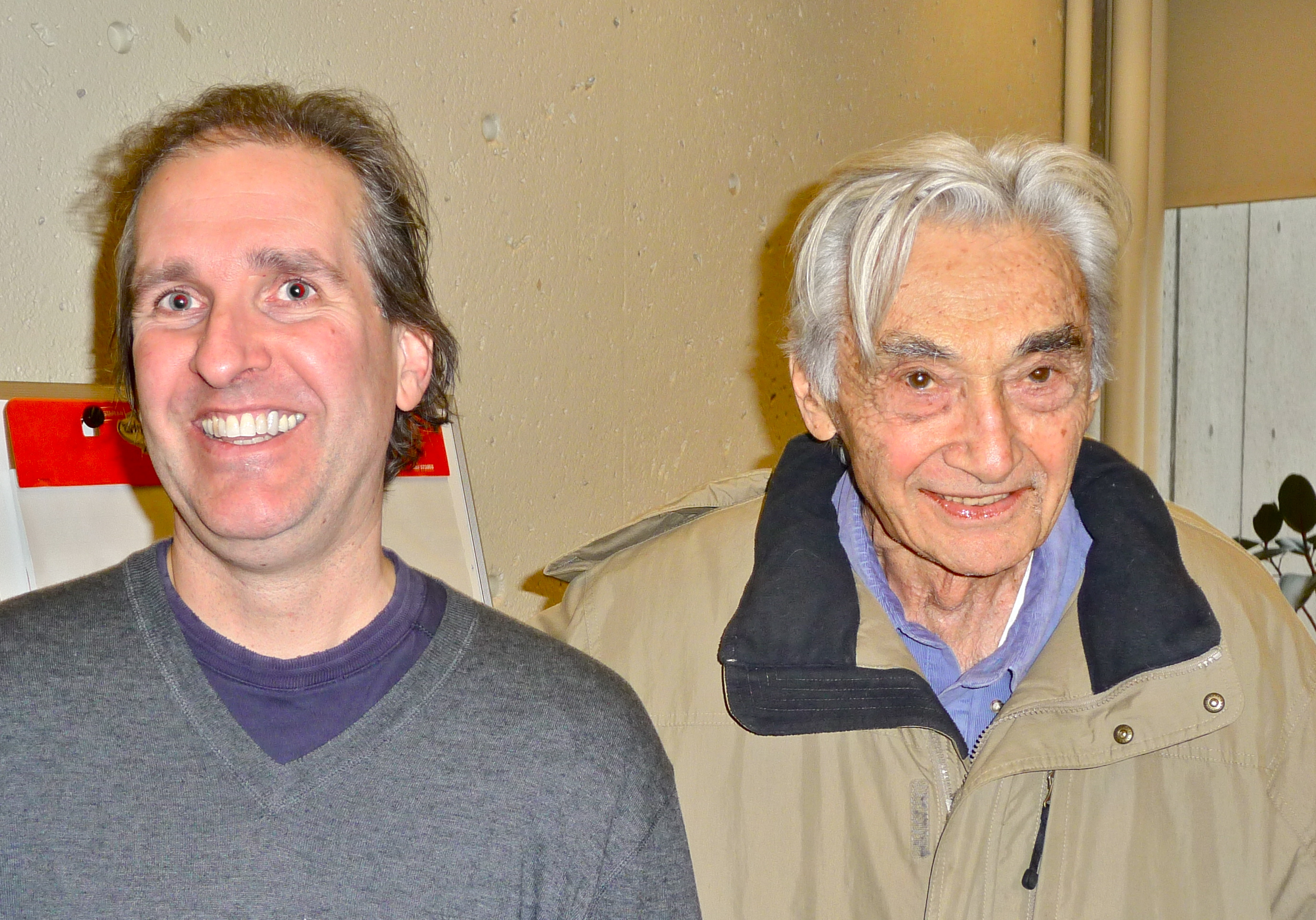
Jack Trumbour and Howard Zinn: photo by Canadian labour leader Nancy Hutchison, taken on Jan 15, after Howard finished teaching the Program.
“Many people know about Howard’s peace activism, but fewer know about his efforts to reach workers and the labor movement,” comments Jack.
“Howard had a lot of issues with serious back pain during the past year, and he had some significant medical attention for this. He indicated that he was doing better, though not great… There have been some fine tributes to Howard. And the bloggers at the nasty right-wing website of David Horowitz have sneered at him, which is to be expected.
“…This is a sad day for us all, but we are hoping Howard’s tireless advocacy for peace might inspire others in 2010 to build a movement that can stop the madness, madness which includes Obama’s support for more global interventions.”
“I would try to be fair to other points of view, but I wanted more than ‘objectivity’; I wanted students to leave my classes not just better informed, but more prepared to relinquish the safety of silence, more prepared to speak up, to act against injustice wherever they saw it. This, of course, was a recipe for trouble” – Howard Zinn in his autobiography, You Can’t Be Neutral on a Moving Train (1994).
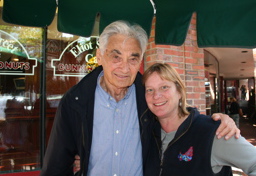
Cambridge, Oct 2006: Howard Zinn and B.J. Bullert. Photo: Beena Sarwar)
Jack was indirectly responsible for my own meeting with Howard Zinn. In May 2006, he had connected me with BJ Bullert, a documentary filmmaker in Seattle, WA, a graduate of Boston University (BA, Philosophy) with an MLitt in Politics from Oxford, with a PhD in Communication (University of Washington). She was interested in finding out more about the Tarbela Dam (her father was an engineer there and she had lived in Pakistan as a 13-year old) and issues of displacement (That is another story).
When BJ visited Cambridge in October 2006, we met for the first time since we had started corresponding. Later, when going to meet Howard, her old teacher, she invited me also. I was thrilled, and took along my copy of his inspirational, best selling book ‘A People’s History of the United States’. The book, currently #4 on the NYT non-fiction best-seller list, has sold more than a million copies and “redefined the historical role of working-class people as agents of political change” (as the LA Times obituary put it).
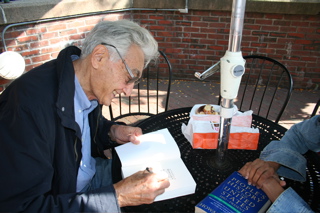
Howard Zinn autographs my copy of People’s History…
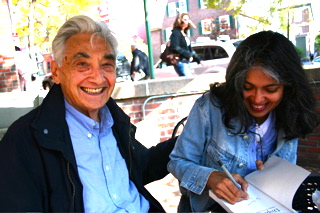
... and graciously makes me sign my offering. Photos: BJ Bullert
We sat outside in the little courtyard at Dunkin’ Donuts opposite the Kennedy School and talked, and joked. He graciously signed my copy of his book and even more graciously asked me to sign a copy of a book I gave him, ‘Dispatches from a Wounded World, (BlueEar & BookSurge, USA & UK, December 2001, to which I had contributed a chapter, ‘The Hijacking of Pakistan’, pushed by Ethan Casey). We joked, bantered and exchanged ideas. Jack turned up later to join us. Howard then had another appointment and we all went on our own ways. But we kept in touch.
Howard was prompt to endorse the ‘Academics’ Statement Of Support For Dr Ayesha Siddiqa’ in June, 2007, after the Musharraf government attempted to intimidate Ayesha following the publication of her book ‘Military Inc.: Inside Pakistan’s Military Economy’. The establishment pressurised the Islamabad hotel where the launch was scheduled to cancel the event. Ayesha’s phone service was disrupted as she gave interviews and she felt increasingly isolated and physically threatened.
The statement reminded the Musharraf administration “that the whole world is watching. The aspirations of the vast majority of the Pakistani people are inclined towards democracy and freedom of expression. It is obstructing these aspirations that will ‘derail the nation from its path of progress and prosperity’ to use a phrase from the press statement issued after the corps commanders meeting.”
Howard was generous in his appreciation for an oped I wrote for the Boston Globe about Pakistan’s struggles a couple of weeks later, saying it gave him “a clearer picture of what is going on in Pakistan, which of course I cannot get in the media.” (I think he meant the ‘mass media, particularly television, because after all, the Globe is media…).
In December 2007, I emailed BJ, Jack and Howard when David Barsamian visited to Pakistan for the Eqbal Ahmad Distinguished Lectures and needed some contacts. “Somebody ought to make a film about David,” quipped BJ.
David Barsamian at T2F (1.0) with Sabeen and Zak listening to an audience comment (March 2008). Photo: beena sarwar
Howard replied playfully, “BJ, a film on David Barsamian is a great idea. You will interview me and I will tell the world what a scoundrel he is. But seriously, you should do it! He deserves it, scoundrel that he is.”
In April 2008, the indefatigable e-campaigner Isa Daudpota emailed a Zinn quote to his mailing list, formatted as a poster that he had put up on his office door:
We need Civil Disobedience!
“Civil disobedience is not our problem. Our problem is civil obedience. Our problem is that numbers of people all over the world have obeyed the dictates of the leaders of their government and have gone to war, and millions have been killed because of this obedience. Our problem is that people are obedient all over the world in the face of poverty and starvation and stupidity, and war, and cruelty. Our problem is that people are obedient while the jails are full of petty thieves, and all the while the grand thieves are running and robbing the country. That’s our problem.”
~Howard Zinn
“Well, that’s nice news about the poster! In Islamabad!” exclaimed Howard when I forwarded it to him.
I visited Cambridge soon afterwards. His wife was ill and he tried to stay home as much as possible. But he added cheerily, “Hope you come back and we’ll have another chance to get together.”
I learnt in September from David that she had passed away soon afterwards. In response to my note of condolence Howard replied: “Roz was diagnosed with ovarian cancer in July of 2007, had six very good months, refusing surgery and chemotherapy, then declined and died in May. lt’s hard, but I’m doing okay.”
Married in 1944, they were inseparable until Roz’s death in 2008. She was also an activist, and Howard’s editor. “I never showed my work to anyone except her,” Bob Herbert quoting him as saying, in his obituary for the NYT.
Howard’s energy was amazing. Shattered by his wife’s passing away, himself well over 80 years old, he continued to write, give talks and interviews. He also embraced new ways of getting the word out, as evident with the publication of ‘A People’s History of American Empire’, the comic book version of “The People’s History of the United States” in 2008 that combines cartoons, historical documents and photos, “making the whole thing visual, dynamic, and absolutely captivating,” as one review put it.
The last email I got from him was about yet another exciting project to spread these ideas and awareness, through the documentary, THE PEOPLE SPEAK. He sent an email out to his contacts about the screening of this film, “directed-produced by Chris Moore, Anthony Arnove, myself, with a great cast of readers and performers. That will be Sunday evening, Dec. 13, 8 PM (7 PM Central) on the History Channel.”
A must-read for any Zinn fan is ‘the most dangerous man in America’ Daniel Ellsberg’s riveting tribute. He recounts that he first met Howard Zinn at Faneuil Hall in Boston in early 1971, “where we both spoke against the indictments of Eqbal Ahmad and Phil Berrigan” for “conspiring to kidnap Henry Kissinger”. He recalls how Howard (who had been arrested in D.C.) returned to Boston for a rally and a blockade of the Federal Building, and was the last speaker at a large rally in Boston Common being addressed over loudspeakers.
Ellsberg writes: ‘Twenty-seven years later, I can remember some of what he said. “On May Day in Washington, thousands of us were arrested for disturbing the peace. But there is no peace. We were really arrested because we were disturbing the war.”
At the end, he said: “I want to speak now to some of the members of this audience, the plainclothes policemen among us, the military intelligence agents who are assigned to do surveillance. You are taking the part of secret police, spying on your fellow Americans. You should not be doing what you are doing. You should rethink it, and stop. You do not have to carry out orders that go against the grain of what it means to be an American.”
He paid for his words the following day when he was singled out for manhandling and arrest.
As the legendary activist and author discussed in one of his final interviews, he wants to be remembered for “introducing a different way of thinking about the world,” and as “somebody who gave people a feeling of hope and power that they didn’t have before.”
Howard Zinn, wherever you are, know that there are people here too who will always celebrate your life and work and who mourn your passing away as a world citizen who cared for humanity above all and did indeed give people “a feeling of hope and power”.
Compilation of tributes and articles related to Howard Zinn, including his own works, at the Howard Zinn website.
Post script: Just came across Mahir Ali’s tribute to Zinn in Dawn, Feb 10, 2010: ‘Lessons from a past master‘ – “Every country would be well-served by a radical public intellectual of comparable erudition, commitment, wit and wisdom. Americans should be very proud of Howard Zinn.”
We Don’t Feel Like Celebrating with Israel This Year Article by Naomi Klein – September 8th, 2009
Last para of Klein’s article:
….This is the context in which a small group of us drafted The Toronto Declaration: No Celebration Under Occupation, which has been signed by the likes of Danny Glover and Ken Loach (we will be unveiling hundreds of new names on the first day of TIFF). Contrary to the many misrepresentations, the letter is not calling for a boycott of the festival. It is a simple message of solidarity that says: We don’t feel like partying with Israel this year. It is also a small way of saying to Mona Al Shawa and millions of other Palestinians living under occupation and siege that we have not forgotten them, and we are still outraged.
Adding Your Name
To add your name to this letter, please send your name, occupation and country to tiff.letter@gmail.com
We will accept signatures until September 14, 2009
For further reading on this issue:
Letter by Canadian filmmaker John Greyson on withdrawing his film from the Toronto International Film Festival in protest against City to City: http://tiny.cc/tiff_open_letter
(not sure I agree with his decision to withdraw his film, but it reminds me of the Modi award going to Gujarat – ‘business as usual’ -beena)





 Journeys to democracy