

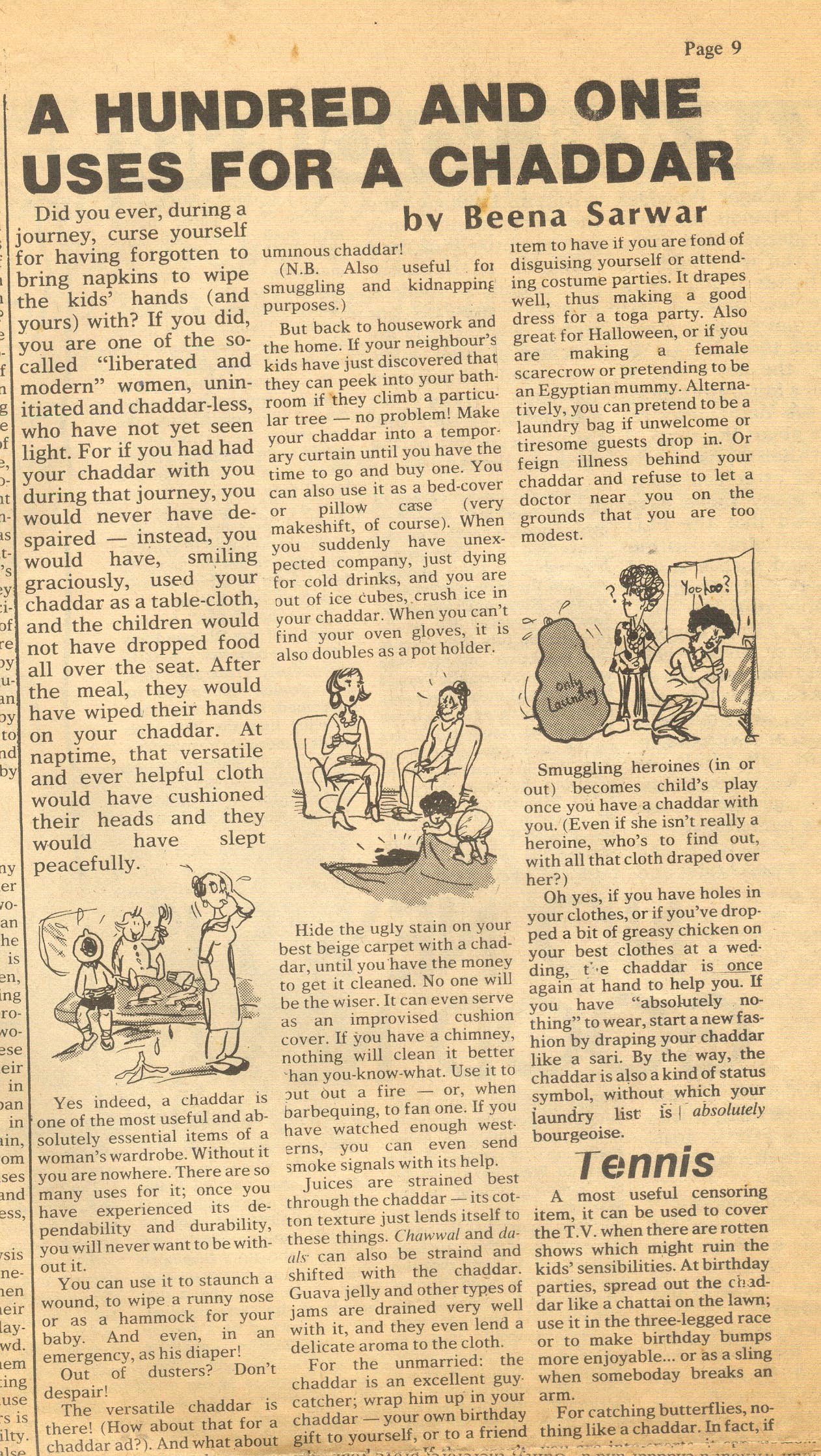
Scan of my 1980s article in The Star, with my illustrations
Filed under: Gender | Tagged: Gen. Zia, Gender, Media, Pakistan | 3 Comments »
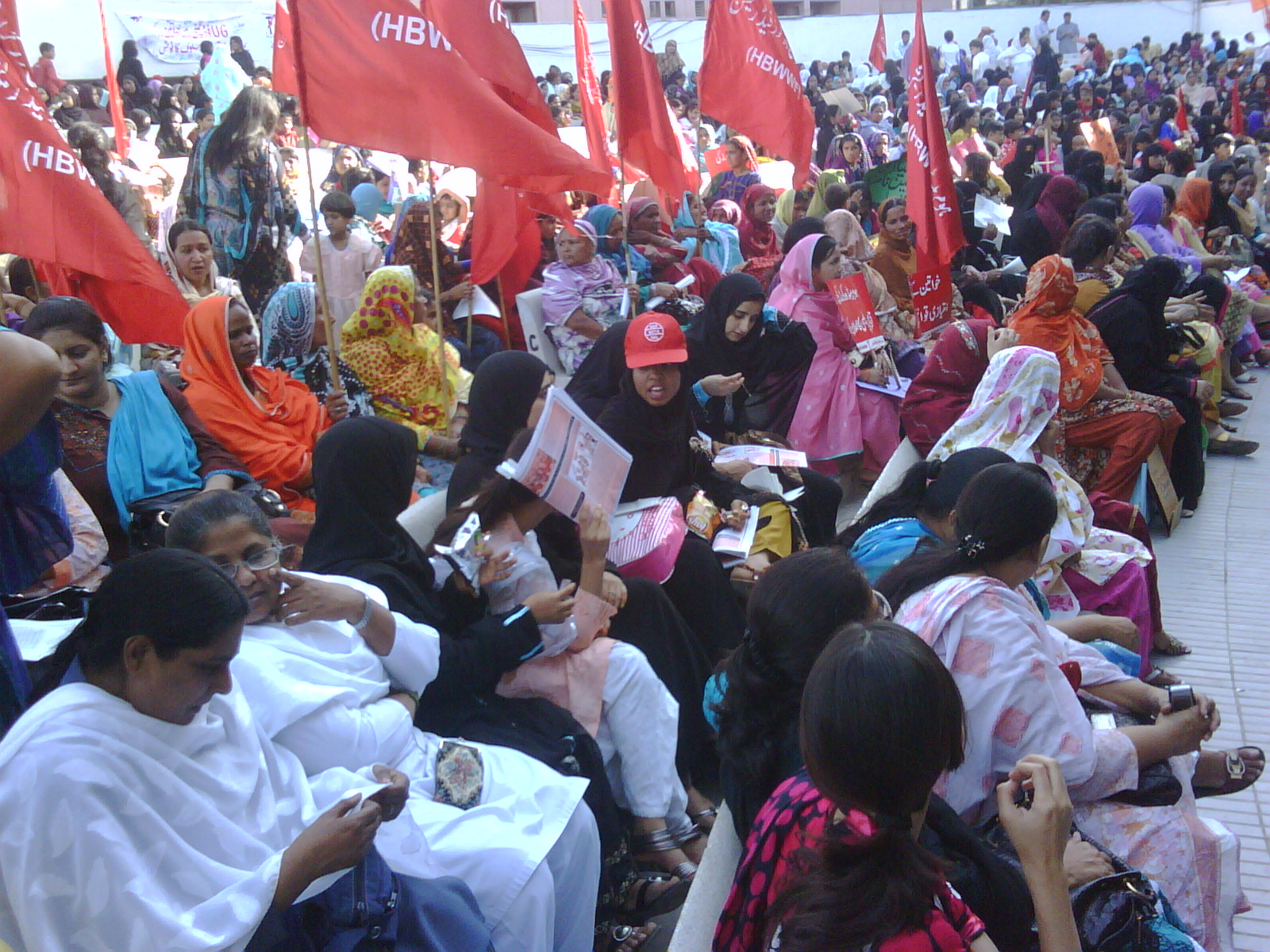
Pakistani women demand their rights. Photo: courtesy Nasir Mansoor, LPP
WOMEN’S DAY RALLY IN KARACHI: Thousands of working class women, many of them home based women workers, with red flags in their hands marched on roads of Karachi, chanting slogans against ‘mullahism’, religious extremism and for their democratic rights. The march started from Karachi Press Club and culminated at the Arts Council of Pakistan where a seminar was held in the open air theatre followed by songs, theatre and documentaries. They demanded: *End all discriminatory laws against women and minorities *End religious fundamentalism *Recognize home based women workers as workers in law, extend social security cover to them *Equal opportunity to women in all fields of life
 Also see: Dedicated to Pyari Pakistanis: Happy Women’s Day, y’all! – a delightful sum up of the situation of Pakistani women, with statistics and action points, by blogger and cartoonist Mehreen Kasana. Check it out 🙂
Karachi rally speakers and demands: Continue reading
Filed under: Gender | Tagged: cartoonist, Education, Gender, health, humour, justice, mehreen kasana, Pakistan, stereotype, Violence against women, women, women's day | 1 Comment »
 Happy to get this email from fellow journalist and activist Naveen Naqvi:
Filed under: Gender | Tagged: abuse, floods, Gender, Pakistan, resistance, take back the tech, violence | 1 Comment »
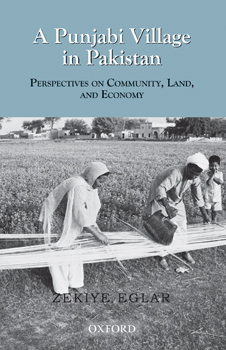 Thrilled to receive my copy of A Punjabi Village in Pakistan – Perspectives on Community, Land, and Economy by Zekiye Eglar, for which I wrote the Introduction, Conclusion, and Bio-note about Eglar, a Russian-Turkish anthropologist, protegee of Margaret Mead at Columbia University. Eglar provides a fascinating account of village life in Punjab, Pakistan, in the late 1940s and early 1950s, when she lived in Mohla, a village not far from Gujranwala.
The OUP publication has compiled her out-of-print award-winning book (A Punjabi Village in Pakistan, Columbia University Press 1960) and its until-now unpublished sequel, (The Economic Life of a Punjabi Village), from a manuscript that Eglar’s friend and protege Fazal Chowdhry brought to the attention of Mary Catherine Bateson (prominent anthropologist, Mead’s daughter).
(I worked on the project for two years under Mary Catherine Bateson’s supervision, recommended to her by our mutual friend, the Iranian anthropologist Shahla Haeri).
From the OUP website: “This volume contains relevant insights into Pakistani society, particularly women, which are still pertinent today, as well as a more holistic and humanistic view of village life in South Asia. Eglar’s study is useful for precisely what she focused on—the patterns of ritual service and gift exchange which underlay every facet of life in a village.”
|
Filed under: Pakistan | Tagged: anthropology, early life pakistan, Gender, gift giving patterns, margaret mead, Pakistan, punjabi village, vartan bhanji, zekiye eglar | 1 Comment »
Analysis by Beena Sarwar
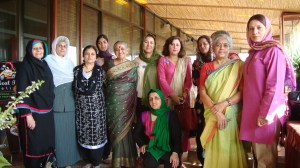
A collective aspiration for peace brings together women from India, Pakistan and Afghanistan. Photo:Roshan Sirran
KABUL, Oct 18 (IPS) – ‘Give peace a chance’ may just be another cliché for many, but for women who have suffered the ravages of war, endless strife and other forms of conflict, joining hands to find meaningful solutions to their collective aspiration lends it a whole new meaning.
Within the South Asian region, Pakistan, India and Afghanistan have for decades been torn by internal and external conflicts that have cried out for, but have not quite found, a lasting resolution.
“We waited for a long time to see what the men would do for peace,” Zahira Khattak, a member of the think-tank formed by Pakistan’s Awami National Party (ANP), told IPS.
Filed under: Peace | Tagged: Afghanistan, Aneesa Zeb Tahirkheli, ANP, Bushra Gohar, Delhi Policy Group Peace and Conflict Programme, Gender, India, jirga gai, Jyoti Malhotra, Nafisa Shah, Nargis Nehan, Pakistan, pakistan afghanistan jirga, Parliamentary Women Caucus, peace jirga, peace trialogue, PPP, PPP Sherpao, Radha Kumar, Roshan Sirran, Shinkai Karokhel, Shukriya Barakzai, women, women peace commission, Zahira Khattak | Leave a comment »
Here’s a note I sent out to the Saneeya Hussain yahoogroup yesterday, Aug 13th, her birthday – please do check out the link about the Saneeya Hussain Trust: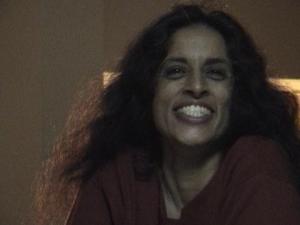
Dear family and friends of Saneeya, scattered all over the world, this huge community of caring and committed people working in all kinds of ways to make the world a better place in their own ways
Here’s to Saneeya – we’ll always miss her. It is wonderful that the Saneeya Hussain Trust is up and running. Please do check it out at http://www.saneeyahussaintrust.com/ – The Trust has already done a lot of valuable work in terms of helping young girls obtain an education.
Several months ago I wrote a chapter for a forthcoming book on environmental journalism being published (eventually, we hope) by Sage, India. It focuses to some extent on Saneeya and Nazeeha had it posted to the SHT website for those who are interested
http://www.saneeyahussaintrust.com/PakistanChapterforSageIndiaAug08.pdf
I finally made a blog (on which I post my own articles and other material that I also send to my issues yahoogroup) – have linked the SHT to it also. I’d encourage all those of you who maintain blogs or websites to do the same.
That’s all for now from hot and muggy Karachi
beena
Filed under: Saneeya Hussain Trust | Tagged: democracy, Education, Environment, environmental journalism, Gender, girls education, Pakistan, Pakistan spaces, saneeya hussain, Saneeya Hussain Trust | Leave a comment »
In this post: Update by Naeem Sadiq,report from Mardan camps by Bushra Khaliq and an appeal by the Muslim Canadian Congress
1. Email from Naeem Sadiq:
There are numerous reports pouring in that highlight the scale and the severity of the crisis and trauma being faced by the displaced persons of Malakand. Just received a very frantic and moving phone call from a friend in Mardan. He is a part of a team consisting of six outstanding young engineers, who took leave from their jobs, collected funds and rations and drove down to the camps in Mardan. He was overwhelmed by what he saw, and his version corroborates with the reports of many other independent reporters, who have reported on similar lines. If one can summarize the situation as it stands today.
Pakistan has a challenge whose dimension is larger than what we have ever been exposed to. This challenge needs every citizen and group to come together. If we fail, we would fail not because there was not enough food or blankets, but because we did not know how to manage a distribution system with efficiency, fairness and dignity.
Naeem’s response to my question about contact details to post out with his note, where people can donate or volunteer: “There are dozens , if not hundreds of agencies and groups who are collecting funds and other relief goods. SUNGI (Omar Asghar Khan’s foundation), Edhi, and almost all political parties, and religious groups are in the field. Then there are indvidual groups (such as the team of six engineers I mentioned), Dr. Awab and his team, Hissar Foundation and many others not known to me who are doing extremely good job. Distribution is the key issue.”
Response to Naeem’s note by Imran Ali posted to the May 12th Group: “Your analysis is on the dot sir. I took a week off to be there. No preparation too many agencies and no coordination. Sir I also found that water and electricity are huge problems, as is the total disillusionment with Pakistan army and government. Taliban are condemned as villain no 2 but a very distant second. There are many heroic assistance efforts but they are not coordinated. Phones communication and coordination are the problem. The operation must finish in two months otherwise it will overwhelm us. The army is confident that it will.”
2. WOMEN’S VOICES – REPORT FROM CAMPS IN MARDAN
Bushra Khaliq, General Secretary, Women Workers Help Line, Lahore, who visited three of camps set up in Mardan, housing some 32,725 persons, mostly from the working class. Their findings in a nutshell, in their words:
Most of the people they spoke to were against both Americans and Taliban. They believe that the army operation was launched under US pressure and that the Army is not sincere in crushing the Taliban. They want some deadline regarding the end of the operation as they want to return home at the earliest.
Every family has been provided with a tent but life is miserable for them in the sizzling heat (over 40 degree Celsius) – a situation made worse by no electricity coupled with poor amenities. There were few dispensaries – Diarrhea, dysentery, skin diseases, eye sores, throat infection are widespread “due to the consumption of unsafe drinking water, smell from filthy toilets and inappropriate food, etc…. Every body has a story to tell but (most) pathetic are the stories of women inside these tents.”
“The good thing is that small children are duly engaged in educational activities. Unicef is providing primary educational service to these children, including school bags and books. Since government schools are closed in Mardan, and teachers were free so these govt school teachers have offered their services to teach children in tent schools.”
Full text of message plus pix at http://groups.yahoo.com/group/socialist_pakistan_news/message/15146
3. Note from Muslim Canadian Congress – Pls pass on to friends & family in Canada
May 19, 2009
MCC condemns Taliban onslaught in Pakistan;
Growing humanitarian crisis needs Canada’s attention
www.muslimcanadiancongress.org
(couldn’t find this note on their website but it was posted to me by someone in Canada)
TORONTO – The Muslim Canadian Congress (MCC) has expressed its deep concern with the humanitarian crisis unfolding in Pakistan where the country’s army is battling the Taliban insurgency. The MCC welcomes the long overdue initiative of the Pakistan Armed Forces to restore the writ of the
democratically elected government. However, the displacement of more than a million people as a result of the Taliban insurgency is becoming a humanitarian crisis, that needs to be tackled on an urgent basis by the international community before these camps become recruiting grounds for the next generation of the Taliban.
The MCC has urged the Canadian Government to take the lead in providing aid to the internally displaced persons (IDPs). If Western governments do not step in with humanitarian aid to these IDPs, the vacuum will be filled by Islamist groups who have already started setting up offices inside these
camps.
Regarding the current relief efforts, MCC president, Hasan Mahmud, has expressed reservations about some of the donations that are being contributed towards the relief efforts for the displaced citizens of Swat by Islamist groups in Canada.
“After the devastating effects of the 2005 earthquake in Northern Pakistan, Islamist charities like the Jamaat Dawa and others operated by Jamaat-e-Islami exploited a tragedy to collect funds which were then used to further their extremist ideology and provide more fodder to the vast network of militias operating under the Deobandi-Wahabi banner.”
A similar initiative by Pakistan’s right-wing political parties (Jamaat-e-Islami, Jamaat Dawa) is currently underway. These groups and individuals raise funds for humanitarian purposes in Pakistan and abroad, as well as seek to portray Taliban as a group that is redressing social and judicial grievances. Despite these portrayals, we have seen nothing but destruction of Pushtoon culture, barbaric massacres of opponents and the Pushtoon Shia population, destruction of educational institutions and imposition of medieval barbarism on hapless population in all areas where Taliban held sway.
Canadians should be wary that their humanitarian donations are strictly allocated to the Red Cross and UN and not to Islamist organizations and individuals like the above mentioned, whose subsidiaries are using it to fund militants that are attacking Canadian troops in the neighbouring country of Afghanistan.
For further information, please call Hasan Mahmud, President of the MCC at
(416) 742-5975
Filed under: 'Internally Displaced Persons' | Tagged: 'War on terror', Gender, IDPs, Pakistan | 1 Comment »
A journalist’s notebook
By Beena Sarwar
In November 1999, like many others, I thought that the Taliban were the ‘last gasp of a dying order’. They were isolated in Afghanistan. The world largely turned a blind eye to their oppressive system imposed in the name of religion — public floggings, limb amputations and executions – for alleged moral transgressions that the Taliban saw as crimes, like adultery. Such punishments were not entirely an aberration in the last decade of the 20th century: USA’s most allied ally, oil-rich Saudi Arabia, routinely meted out similar punishments (and continues to do so). The Taliban in Afghanistan controlled an area across which America wanted to build an oil pipeline. Until they refused to allow this, their ‘barbarism’ received little notice in the West, particularly America.
The Taliban’s attitude towards women was an extreme version of attitudes generally prevalent in the context of this region. Women across South Asia are verbally and physically abused every minute of the day, every day of the year. ‘Honour killings’ in one form or other are common all over the Middle East as well as South Asia, in addition to the ‘dowry deaths’ and female foeticide prevalent in India. At least 1,210 women were killed in Pakistan during 2008, including at least 612 in so-called ‘honour killings’ and at least 185 over domestic issues, according to the recent annual report of the Human Rights Commission of Pakistan (HRCP).
“The malaise is more widespread than we care to acknowledge,” wrote Jawed Naqvi in his column My fanatic versus your fanatic (Dawn, reproduced in www.hardnewsmedia.com), after the ‘Swat flogging video’ came to public notice. Highlighting gender violence in various societies including India, he comments, “What goes for religious fanaticism elsewhere can easily mutate into caste bigotry in a country like India. Although caste-based zealotry goes largely unnoticed because of its prevalence in under-televised rural areas, it works with the brutality associated elsewhere with honour killings and violence against women generally.”
In Pakistan, as well as in India and other societies where there is gender violence on the pretext of ‘honour’, the perpetrators tend to be family members. People often overlook or condone such violence as an internal, domestic matter. The culprits are rarely punished, particularly if they have acted against a daughter who eloped against their wishes with someone and that too from a different or ‘lesser’ community.
The difference is that the Taliban in Pakistan, in their role of extra-judicial vigilantes, punish women they are not related to, assuming the role of the State. Their Hindu counterparts may aspire to similar levels of vigilantism, judging by the Rightwing threats and attacks on women who transgress conservative norms in India – “Indian Taliban” as one Indian minister termed Hindu vigilantes who beat up women in a pub in Mangalore.
The comparison is not too far-fetched. Five years ago, I remember the US-based Indian filmmaker, Lalit Vachani, saying that many leaders of the Hindu Right “want a mirror image of Islam” – they want to manufacture, “a religion where a (spiritual) leader will give fatwas that the faithful will follow blindly.” He was speaking at a discussion after the screening of his documentary about the RSS, The Men in the Tree (2002) in Delhi.
Writing about the event that I happened to have attended, his words reminded me of an Australian PhD candidate working on a comparison of Hindu and Muslim Rightwing organisations some years ago, mainly in Mumbai and Lahore. She found that the Hindu organisation actually studied the tactics of the Islamic organisation, including pamphlets, literature, and video recordings of their rallies. (Having received various threats from their representatives in Australia when she returned, she preferred to remain anonymous).
In the same article, I quoted TV journalist Rajdeep Sardesai, who, during a live talk show on Geo TV during the Saarc summit in Islamabad in January 2004, had told the Jamaat-e-Islami chief Qazi Hussain Ahmed during a heated debate on Kashmir and religious extremism, “Qazi sahib, mujhe lagta hai ke aap aur Bal Thackeray ek hi sikkey ki do sides hain” (it seems to me that you and Bal Thackeray are just two sides of the same coin). Qazi had no answer. (The commonality of ‘fundamentalisms, October 10, 2004). More from that article:
“Sardesai’s brief remark pinpoints a fundamental and universal truth: the commonality of ‘fundamentalisms’, no matter how much at odds they appear to be. Unfortunately, they tend not to stick to the actual ‘fundamentals’ that are common to all religions – truth, justice, and compassion. As a result, another commonality is how their respective ideologies contribute towards a culture that condones and engages in violence – a point underscored decisively in Vachani’s film…
“In general though, there is little acceptance in India for such homogenisation, that many oppose, because it leads to violence that, in turn, will isolate the country. Vachani’s The Men in the Tree, in fact, makes the case that this homogenisation also prepares the ground for incidents like the Babri Masjid demolition, and beyond, to the horrors of Gujarat (2002). This brings up another commonality between extremist groups: their attempts to construct and strengthen their own identity by demonising ‘the other’ even if this means distorting history.”
In Pakistan, the growth of the Religious Right and subsequently the Taliban’s revival has much to do with the military’s continuous meddling in politics. Impatient with bungling and corrupt politics, sections of the population welcome or at least wearily accept military takeovers instead of pushing for the political process to continue.
When the citizenry is allowed to have a voice, it blunts the edges of extremisms, as we have seen in America and India. Elected leaders can sometimes be disastrous, but being in the political mainstream forces them to compromise, dialogue, negotiate, and step down from hardline positions – except when they sound the drums of war, a situation that allows for the revival of extreme positions based in manufactured notions of nationalism. Even so, when the political process is allowed to continue, every few years the people have the power to vote out an elected representative who has exploited nationalist or religious sentiments. A military man who takes over is accountable to no one. He cannot be dislodged by elections and stays on until he is forced out – in Pakistan, after an average of ten years. The presence of a military strong man at the helm of affairs keeps the lid on simmering discontents, allowing extremism to grow.
If the law and order situation is simultaneously allowed to grow out of control, criminalisation feeds into this extremism. Citizens feel emasculated and powerless; aggression and violence is one way of self-assertion. In Pakistan, since September 2001, the focus on the ‘law on terror’ at the expense of the police force and the criminal justice system, has allowed ‘religious militancy’ and extremism, already strengthened in the name of ‘jihad’ since the Afghan war against the Soviets, to dig deeper into society. These trends were reinforced and institutionalised by discriminatory laws enacted in the name of religion by the previous military ruler, Gen Zia-ul-Haq, propped up by America for his role in that war.
“This has led not just to greater discrimination against religious minorities, it has caused sectarian confrontation within the Muslim population, conflict between the orthodoxy and liberals over observance of social mores, and a running polarisation between the political Right and Left. Today, we are faced with two stark choices: modernisation and development, or regression into tribalism,” this reporter wrote in a comment on November 1999 (The Democracy Debate). Here’s more from that article:
“The country Gen. Pervez Musharraf has taken upon himself to lead, faces a conflict between these two trends that is intensified by increasing exposure to the outside world, access to the satellite dish and the internet, and education, particularly of girls and women even in remote villages and rural areas. On the other hand is ‘Talibanisation’ – fed by thousands of religious seminaries across the country, functioning with government sanction and even money, besides covert funds from other Islamic countries. The last gasp of a dying order?
“… ‘Talibanisation’ is still a serious threat, but it needs to be addressed beyond the surface – deprivation and the denial of basics like health, education and employment opportunities are among the factors behind the increasing number of boys being sent into madrasas where they are at least guaranteed food, shelter, education and even employment later as fighters. “The sectarian nature of most of these madrasas has contributed to the increasing sectarian violence in the country. The only thing that they agree upon is that the others are infidels, along with Ahmedis and pro-democracy, pro-human rights workers; many consider it legitimate to wipe out these ‘ideological enemies of the State’. “…Lack of participatory decision-making, the lack of freedom of information and expression, combined with the State’s own tendency to use violent methods to crush dissent, has contributed to a culture of fear and aggression.
“It is a combination of all these factors that endangers democracy in Pakistan. Short-sighted policies implemented for political expediency will lead to the strengthening of a Taliban-like order, with long-term negative impacts not just for Pakistan but for the entire region and beyond. For Pakistan, it will spell economic disaster and isolate it as a pariah in the world community. A nuclear pariah, which the world cannot afford to ignore. “This is why the world must link demands for guarantees of democracy in Pakistan with economic cooperation, and this is why the people of Pakistan must demand a return to the democratic process.”
Last year, Pakistan again took a step towards the democratic process. But the forces that now hold the country hostage had gained in strength over the previous three decades of military rule (Gen Zia), followed by a decade of musical chairs in which four elected governments were dismissed, followed by yet another decade under military rule (Gen Musharraf). During this time, these forces have consolidated their hold on areas of Pakistan and extracted a heavy price for political short-sightedness and insistence on ‘strategic depth’: the life of Benazir Bhutto. Had it not been for her insistence on electoral politics, Musharraf was unlikely to have shed his uniform and eventually stepped aside – the first military ruler of Pakistan to ‘voluntarily’ relinquish his position.
Still, the results of the February 2008 elections gave room for optimism as, despite threats of violence, the electorate categorically voted against those playing the religious card and those propped up by the military. The events of the past year are eroding that optimism, now overshadowed by the all-too familiar impatience and frustration with the political process. But the last thing we now need is another military takeover or a change of government. Whoever is at the helm of affairs will face the same challenges as the present regime. The fanaticism in the name of religion, developed and cultivated for decades by the powers that be, will not disappear overnight with the restoration of democratic politics.
Whatever its weaknesses and faults, the present government is the first in Pakistan that is really committed to combating this menace, recognising that it will consume us if we do not end it. For the first time, the army chief has spoken out about the Swat deal, terming it an “operational pause”. The Taliban’s continuous reneging from agreements made with the government may yet turn the tide against them and enable the military to move decisively against them, which it has so far been unable, or unwilling, to do.
Meanwhile, for the bulk of the population, the primary concerns remain how to feed, clothe and house themselves and their families, educate their children, get clean drinking water and adequate medical help. This is unlikely to change for the better anytime soon, no matter which way the political winds blow. But a sustained political process, at least, offers a chance for positive change – eventually. The alternative is too grim to contemplate.
Filed under: 'War on terror', Gender, Politics | Tagged: 'War on terror', Gender, Talibanisation, Violence against women, Women and Muslim laws | 1 Comment »
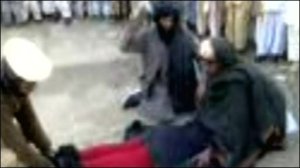
Girl being flogged: Still from the cell phone video circulated on the Internet and broadcast (repeatedly) on the private channels
The ‘Swat flogging video’ has made headlines all over. Zubeida Mustafa in her excellent article in Dawn today, ‘A catalyst for change? analyses the reasons why
This para jumped out at me: “The Swat flogging video has brought people face to face with the reality of the emergence of extremism in the name of Islam. It has brought to the surface the paradoxes that had until now been swept under the carpet for expediency’s sake. The video has forced difficult choices on the people compelling them to at least think about issues that affect them very personally.”
Zia’s children, by Ayesha Siddiqa in The News, April 05, 2009 highlights the issue of ‘Islamic law’ or ‘Sharia’. She references the recent book by Tahir Wasti ‘Application of Islamic Criminal Law in Pakistan: Sharia in Practice’. Wasti, as she points out, has experience of both Islamic law and British common law. “This is the first detailed research enlisting the ramifications of the application of sharia law in Pakistan. tracing the historical roots of this phenomenon”.
For those who haven’t followed the issue or seen the video (warning, it’s graphic) check out Declan Walsh’s initial report on the issue in The Guardian, April 2, 2009 (two days before TV channels in Pakistan picked it up):
Re: my own take – I’ve been swamped with the final editing of another documentary I’m making, but wrote something on the issue the other day that I will share after publication.
Filed under: Gender | Tagged: Ayesha Siddiqa, chief justice iftikhar choudhry, Declan Walsh, flogging, Gender, Pakistan, Swat, terrorism, violence, Violence against women, women, Women and Muslim laws, Zubeida Mustafa | Leave a comment »
‘Celebrating Saneeya’ – feminist, activist, environmentalist, my former editor, and dear friend. Made this 5-min documentary after she died in Brazil in 2005… Saneeya, we will always miss you and be inspired by you and your infectious laughter… See also Saneeya Hussain Trust
http://saneeyahussaintrust.com/
Filed under: Education, Environment, Gender, Politics | Tagged: documentary, Gender, Pakistan, panos south asia, Politics, saneeya hussain, south asia, women's rights | 6 Comments »


 Journeys to democracy