Goodbye Safi Lala. A cousin remembers FC Commandant Safwat Ghayyur

A brave man. You will be missed.

From: Foqia Khan
To: undisclosed-recipients
Sent: Friday, August 06, 2010
Subject: FC Commandant Safwat Ghayyur- a cousin’s memoir (by Kiran Nazir Ahmed)

The whole country is mourning the brutal death of FC Commandant Safwat Ghayyur in Peshawar two days ago in a suicide bomb attack. His excellent leadership skills in times of crisis in Peshawar used to calm raw nerves around the country. He was an excellent officer, always leading from the front and putting his life in danger. His TV appearances always showed his professional distinction and cultured personality. He was my dear friend Kiran Nazir Ahmed’s first cousin and below is a touching memoir by her. Continue reading

Urgent help needed for people of flood-destroyed Sibi, Balochistan

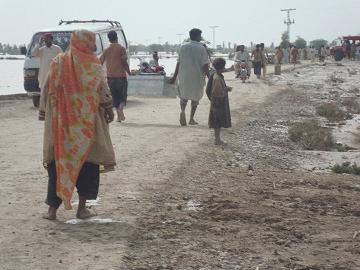
Flood affected villagers move to safer areas. Photo courtesy IDSP

On July 21, heavy rainfall in district Sibi and nearby mountains resulted in heavy floods in River Talli, destroying the safety dam of village Union Council Talli, District Sibi. Over 80 have died, and more than 150 are still missing. Over 57,000 people have been affected in Sibi, Lehri, Barkhan.The floods have damaged 90% of the houses, over 50% livestock and agriculture.
According to the district agriculture and revenue departments these floods have broken the past records of 1978 which also resulted in huge destruction.
A team from Dr. Quratulain Bakhteari’s well-regarded organisation in Balochistan, the Institute for Development Studies and Practices (IDSP) recently visited the affected villages and met with the people there. Dr Bakhteari has sent out an appeal urgently seeking the following items: Food    Water     Tents

Please contact: Alam Baloch / Safdar Hussain
IDSP – Sibi Campus,  Near Radio Station, Luni Road, Sibi, Balochistan.
Telephone: office +92-833-500192  Mobiles: +92-331-8392503, +92-333-7801886


IDSP-Pakistan, Pakistan [IDSP-PAKISTAN]. H.No. 7-A, Al-Mashraq Street, Arbab Karam Khan Road Quetta, Pakistan. T. +92.81.2471776, 2470243 F. +92.81.2447285. idsp@idsp.org.pk

‘Making windows into men’s souls’

Benazir Bhutto on arrival in Karachi, Oct 2007. Photo: Beena Sarwar

Slightly revised version of my column in Hardnews January issue, published in The News on Sunday, Jan 3, 2010, written on Dec 25 with a recent postscript.

PERSONAL POLITICAL: Making windows into men’s souls

Beena Sarwar

Writing this on Dec 25, 2009, two words come to mind – ‘morality’ and ‘terrorism’.

Flashback to the first Al Qaeda arrest, Feb, 1995: Pakistan’s Federal Investigation Agency (FIA) picks up Ramzi Yousaf, the Kuwaiti-Pakistani behind the 1993 World Trade Center car bomb that killed six people (the target was thousands). His arrest is credited among others to then FIA additional director Rehman Malik (current Minister for the Interior).

June 1997: Then opposition leader Benazir Bhutto mentions Malik in her diary series for Slate, A Week in the Life of Benazir Bhutto, writing in her entry of June 21, 1997 about a prison visit to Wajid Shamsul Hasan (currently Pakistan’s High Commissioner in London): Continue reading

Lagay Raho, Media Bhai (Keep At It, Brother Media!)

See article below, posted with this comment by Shaheryar Azhar, Moderator, The Forum: “What is amazing is that people like Kamran Khan, Shaheen Sehbai and then politicos like PMLN (and PPP to be sure as in 1999) and everyone in between have such low opinion and regard for democracy that for all kinds of invented reasons they are ready to sacrifice it at a drop of a hat. They are or unwittingly become instruments of the Army. No one has the mental toughness to ask the difficult questions or patience to let the political process sort out the incompetent and the corrupt overtime. Irony of irony is that, in turn, each of them have themselves been a victim of the same establishment whose line they now toe. What accounts for this short-sightedness? Are they too self-absorbed, too bereft of core beliefs, too egotistically driven, too lacking in wisdom to see the circus of repeating rings! This is a great article by Sadiq Saleem because he is raising the logical issues – one can already see an alternative narrative developing here, which can, one hopes, lead one day to the true practice of the Charter of Democracy.”

Lagay Raho, Media Bhai (Keep At It, Brother Media!)
The News, November 04, 2009
By Sadiq Saleem
On Monday, November 2, thirty-five innocent Pakistanis lost their lives to a terrorist attack. These were ordinary people, standing in line at a bank to receive their monthly salary. They must have gone there with plans of spending that money on their parents, wives, children, brothers and sisters. But for the Pakistani media, especially the TV anchors who have now become the arbiters of what is important and what is not, the death of these poor people was not important. With their usual cast of characters from —Jamaat-e-Islami to Imran Khan to the two Muslim Leagues— the electronic media that day was exclusively focused on the so-called NRO issue.

The long war – Personal Political column in Hardnews

Oct 22, 2009: Slightly amended version of my column for Hardnews, November 2009 issue

PERSONAL POLITICAL

Beena Sarwar

My 13-year old daughter and her friends were thrilled when the government announced a nation-wide closure of schools for the rest of the week. Their joy dimmed when they learned why: suicide bombers at Islamabad’s co-ed Islamic University had killed several students. Amidst fears that more educational institutes would be targeted, armed forces-run schools were already closed.

Pakistan is at war. The entire country is the battleground. The series of bomb blasts gained momentum as expected, in the run-up to Oct 17 when the army launched its ground offensive in South Waziristan.  During the first two weeks of October, militant attacks killed over 150 people, including some 40 on a deadly Thursday in Lahore, Kohat and Peshawar.

Continue reading

‘Kary Logar’ ain’t the issue

My article on the ‘Kerry Lugar Bill’ and the crisis Pk faces today – a slightly edited version of which was published in Dawn today as KLB is not the issue

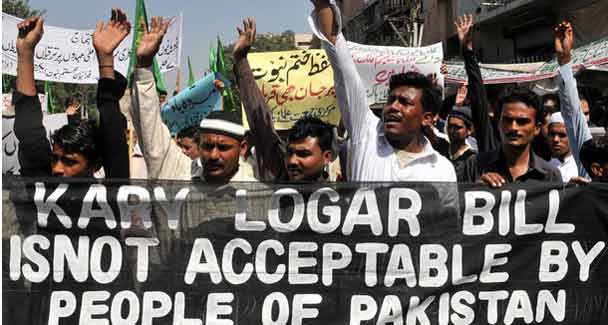
Photo from the demonstration on Oct 11. Courtesy www.dawn.com

Photo from demonstration on Oct 11. Courtesy http://www.dawn.com

‘Kary Logar’ ain’t the issue

Beena Sarwar

As pressure mounted in South Waziristan with the army action, and retaliatory bombings began, a demonstration in Karachi by parties that claim religion as their raison d’etre underscored some key conflicts Pakistan faces: the requirements of justice under due process of law versus tribal, extra-judicial punishments, tensions between the elected civilian government and the ‘establishment’, and conflict between a long-standing foreign policy versus new domestic compulsions.

Continue reading

A 1991 NYT report, sadly still relevant

Shaheryar Azhar, moderator The Forum, makes some relevant points based on ‘In Pakistan, War Stirs Emotions and Politics’ by Barbara Crossette, Feb 1, 1991, New York Times.

In Pakistan, War Stirs Emotions and Politics

By BARBARA CROSSETTE, Special to The New York Times
Published: Friday, February 1, 1991

Reactions to the American-led war against Iraq have created political havoc in Pakistan, where the Government of Prime Minister Nawaz Sharif has been trying to stabilize the country and restart the economy after a year of domestic turmoil.

A rift of unpredictable consequences has opened between the Prime Minister, who generally supports the Saudi Arabian and allied view on Iraq, and the Pakistani military, which is still smarting from the cutoff of American aid in October. [Complete article here]

Continue reading

Tomdispatch site and Ortiz: ‘A moment of silence before I start this poem’

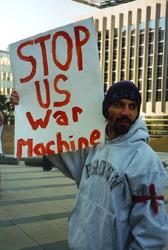
Emmanuel Ortiz protests in front of the Minneapolis Federal Building against the U.S. bombing of Sudan and Afghanistan - August 21, 1998 (http://www.cpinternet.com/mbayly/facesofresistance1.htm)

Emmanuel Ortiz protests in front of the Minneapolis Federal Building against the U.S. bombing of Sudan and Afghanistan - August 21, 1998

1. A must read: Tomgram: Rebecca Solnit, 9/11’s Living Monuments
http://www.tomdispatch.com/ (thanks Dr Ehtisham)

2. I remember reading this powerful poem before; thanks to Shahzad Nazir Khan
for posting it again

Photo from: Faces of Resistance

A MOMENT OF SILENCE, BEFORE I START THIS POEM

By EMMANUEL ORTIZ, 11 Sep 2002

Before I start this poem,
I’d like to ask you to join me
In a moment of silence
In honor of those who died in the World Trade Center and the
Pentagon last September 11th.

I would also like to ask you
To offer up a moment of silence
For all of those who have been harassed, imprisoned,
disappeared, tortured, raped, or killed in retaliation for those strikes
For the victims in both Afghanistan and the U.S.

And if I could just add one more thing…
A full day of silence
For the tens of thousands of Palestinians who have died at the
hands of U.S.-backed Israeli
forces over decades of occupation.
Six months of silence for the million and-a-half Iraqi people,
mostly children, who have died of
malnourishment or starvation as a result of an 11-year U.S.
embargo against the country.

Before I begin this poem,
Two months of silence for the Blacks under Apartheid in South Africa,
Where homeland security made them aliens in their own country.
Nine months of silence for the dead in Hiroshima and Nagasaki,
Where death rained down and peeled back every layer of
concrete, steel, earth and skin
And the survivors went on as if alive.
A year of silence for the millions of dead in Vietnam – a people,
not a war – for those who
know a thing or two about the scent of burning fuel, their
relatives’ bones buried in it, their babies born of it.
A year of silence for the dead in Cambodia and Laos, victims of
a secret war … ssssshhhhhhh…
Say nothing
we don’t want them to learn that they are dead.
Two months of silence for the decades of dead in Colombia,
Whose names, like the corpses they once represented,
have piled up and slipped off our tongues.

Before I begin this poem.
An hour of silence for El Salvador …
An afternoon of silence for Nicaragua …
Two days of silence for the Guatemaltecos …
None of whom ever knew a moment of peace in their living years.
45 seconds of silence for the 45 dead at Acteal, Chiapas

25 years of silence for the hundred million Africans who found
their graves far deeper in the ocean than any building could
poke into the sky.
There will be no DNA testing or dental records to identify their remains.
And for those who were strung and swung from the heights of
sycamore trees in the south, the north, the east, and the west…

100 years of silence…
For the hundreds of millions of Indigenous peoples from this half
of right here,
Whose land and lives were stolen,
In postcard-perfect plots like Pine Ridge, Wounded Knee, Sand Creek,
Fallen Timbers, or the Trail of Tears.
Names now reduced to innocuous magnetic poetry on the
refrigerator of our consciousness …

So you want a moment of silence?
And we are all left speechless
Our tongues snatched from our mouths
Our eyes stapled shut
A moment of silence
And the poets have all been laid to rest
The drums disintegrating into dust.

Before I begin this poem,
You want a moment of silence
You mourn now as if the world will never be the same
And the rest of us hope to hell it won’t be.
Not like it always has
been.

Because this is not a 9/11 poem.
This is a 9/10 poem,
It is a 9/9 poem,
A 9/8 poem,
A 9/7 poem
This is a 1492 poem.

This is a poem about what causes poems like this to be written.
And if this is a 9/11 poem, then:
This is a September 11th poem for Chile, 1971.
This is a September 12th poem for Steven Biko in South Africa, 1977.
This is a September 13th poem for the brothers at Attica Prison, New York, 1971.
This is a September 14th poem for Somalia, 1992.
This is a poem for every date that falls to the ground in ashes
This is a poem for the 110 stories that were never told
The 110 stories that history chose not to write in textbooks
The 110 stories that CNN, BBC, The New York Times, and Newsweek ignored.
This is a poem for interrupting this program.

And still you want a moment of silence for your dead?
We could give you lifetimes of empty:
The unmarked graves
The lost languages
The uprooted trees and histories
The dead stares on the faces of nameless children
Before I start this poem we could be silent forever
Or just long enough to hunger,
For the dust to bury us
And you would still ask us
For more of our silence.

If you want a moment of silence
Then stop the oil pumps
Turn off the engines and the televisions
Sink the cruise ships
Crash the stock markets
Unplug the marquee lights,
Delete the instant messages,
Derail the trains, the light rail transit.

If you want a moment of silence, put a brick through the window of Taco Bell,
And pay the workers for wages lost.
Tear down the liquor stores,
The townhouses, the White Houses, the jailhouses, the
Penthouses and the Playboys.

If you want a moment of silence,
Then take it
On Super Bowl Sunday,
The Fourth of July
During Dayton’s 13 hour sale
Or the next time your white guilt fills the room where my beautiful
people have gathered.

You want a moment of silence
Then take it NOW,
Before this poem begins.
Here, in the echo of my voice,
In the pause between goosesteps of the second hand,
In the space between bodies in embrace,
Here is your silence,
Take it.
But take it all…
Don’t cut in line.
Let your silence begin at the beginning of crime.
But we,
Tonight we will keep right on singing
For our dead.


Emmanuel Ortiz is a third-generation Chicano/Puerto Rican/Irish-American community organizer and spoken word poet residing in Minneapolis, MN. He currently serves on the board of directors for the Minnesota Spoken Word Association, and is the coordinator of Guerrilla Wordfare, a Twin Cities-based grassroots project bringing together artists of color to address socio-political issues and raise funds for progressive organizing in communities of color through art as a tool of social change.

(Note: This is the information that came with the posting I received – have been unable to find any more information on Ortiz; if anyone knows more eg a website or blog, pls do let me know. thanks)

Three ‘9/11’s…

9/11: Anis Mansoori of FM 103 in his live talk show today brought up the  significance of two 9/11s – Sept 11, 1948, when Mohammad Ali Jinnah breathed his last, and Sept 11, 2001 when two planes crashed into New York’s Twin Towers, catalysing a spiral of violence from which we have yet to emerge. My comment was that if successive Pakistani governments had not discarded Jinnah’s vision and headed down the ‘jihadi’ path at the behest of America in its fight against the USSR in Afghanistan, perhaps the second ‘9/11’ would not have happened.

Another 9/11 to remember: Allende ousted

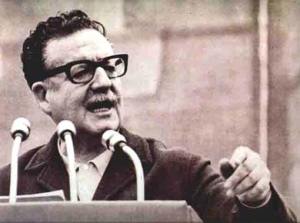
Another 9/11 to remember: Allende ousted

And Mohsin Sayeed reminds me about another 9/11, in 1973 – the US-backed military coup in Chile, that removed the world’s first elected Marxist government. “I don’t see why we need to stand by and watch a country go Communist due to the irresponsibility of its people,” said Henry Kissinger about the coup.

The deposed Dr Salvadore Allende was killed and Gen. Pinochet  unleashed a reign of terror and massacred between 32,000 to 80,000 people…

Target killing of doctors; my article of 2002; Dr Sarwar on censoring Jinnah, 1991

A press release from PMA condemning the ongoing target killing of doctors in Pakistan reminded me of a piece I had written in 2002, published in the Indian Express – googled the key words and found it. Ah, Internet.

There are also new uploads in the ‘Writings’ section of the blog Dr Sarwar blog – including ‘Censoring the Quaid’, a piece Dr M. Sarwar wrote in 1991 for his fortnightly column ‘Karachi calling’ in The Frontier Post, Lahore. Particularly relevant given the Jaswant Singh and Jinnah controversy.

In its press release of August 21, 2009, the Pakistan Medical Association, Karachi strongly condemns yet another murder of Dr.Sajjad Arain in Hyderabad, killed on his way to work at Civil Hospital, Hyderabad. A similar incident had also occurred a couple of days before in Quetta when Dr.Iqbal Zaidi was killed by unidentified miscreants. “By now this easy phenomena of killing doctors has become a routine, and right to life of those who are providing soles to humanity irrespective of sex, colors, religion or beliefs, is sadly no more available to them in the country,” says PMA, demanding the immediate arrest of culprits. If stern action is not taken with in 24 hrs the doctors community will be forced to stage country wide protest by calling total shut down of health services in the country.  http://health.groups.yahoo.com/group/pakistanmedicalassociation

Below, my article in Indian Express, April 2002: http://www.indianexpress.com/storyOld.php?storyId=1097

Targeted doctors ask what about us as Gen fights US war against terror

Apr 19, 2002

Beena Sarwar

For some days now, Karachi has thankfully not woken up to the news of yet another medical doctor shot dead in cold blood. But as an editorial in The News (April 16) cautions, ‘The current let-up in the assassinations does not mean that the issue should be allowed to quietly die down, or overshadowed by the controversial referendum. The question of who is behind the killings and why still begs to be answered, and must be answered sooner rather than later.’

Over the last decade, almost 90 doctors, mostly Shi’ite, have been assassinated, causing widespread fear and insecurity, and leading to a veritable exodus not just of medical practitioners but also their relatives in other professions. Dr Tipu Sultan, Karachi President of the nation-wide Pakistan Medical Association (PMA), knows of at least 28 doctors who left Karachi in one week in March.

Obviously, whoever is behind these murders wants to make an impact: a doctor killed demands media attention, and creates far-reaching ripples, given each doctor’s contact with hundreds of patients and their families; their very public dealing makes them vulnerable.

Assassins turn up at a targeted doctor’s clinic, and ask for him by name to identify him, as in the case of Dr Rashid Mehdi, 39 on February 12. He was shot dead, leaving behind a young wife, also a doctor, a little son, and a five-day-old daughter.

The pattern includes armed motorcyclists intercepting a doctor’s car and shooting him at point blank, as in the case of Kidney Centre nephrologist Dr Alay Safdar Zaidi, killed on his way to work on March 4. Dr Zaidi had returned to Pakistan a year and a half ago, leaving a thriving practice in the States to come back and make a difference here.

His daughter, aged six, and son, only three, are now among the dozens of other children whose fathers were similarly assassinated, despite not being affiliated with any religious or political party or even holding aggressively Shia views.

In one instance, the assailants used a car to force a doctor’s car to a stop. Dr Jafar Naqvi of the philanthropically run Kidney Centre was saved by his driver’s reflexes.

Dr Naqvi, saved by taking refuge in a private house, is now virtually confined to his own house, with round-the-clock police protection.

Most victims are Shi’ite, but they include some Sunnis too, like Dr Fayyaz Karim, 44, shot on Feb 4 as he left a mosque after offering his prayers. His wife, Dr Farahnaz Karim, says bitterly that it’s commendable that the Government is helping Americans wipe out terrorism. ‘‘But what of the terrorists in our midst who are killing our own countrymen?’’

The killings have forced an organised response from doctors, with the PMA calling several strikes (including a six-hour country-wide hunger strike) during which doctors at hospitals and clinics across the country provide only emergency cover. ‘‘This is not the answer,’’ concedes Dr Asghar Mirza, editor of the PMA’s Urdu journal Nabs. ‘‘But how else do we express our rage and fear?’’

When the PMA met the Sindh Governor last month, police officials suggested a ban on motorcycle pillion riding, and arms training and protection to threatened doctors. ‘‘This is not the answer either,’’ says prominent psychiatrist Dr Haroon Ahmed. ‘‘They are trying to use us to push through their own agenda.’’ He argues, like others, that administrative steps alone are not the answer.

‘‘The Government must restore civil and political liberties so that alternative opinions are given space, and tolerance and respect promoted,’’ demanded the Pakistan Peace Coalition (PPC) at a nation-wide protest on April 5 against violence in the name of religion. ‘‘This will likely provide a necessary challenge to extremism, as well as temper the urge for many frustrated elements to resort to reactionary violence.’’

Political parties in Karachi, including major players like the Pakistan People’s Party (PPP) and the Muttahida Qaumi Movement (MQM), joined the protest on the invitation of the Joint Action Committee for Peace Karachi (JAC), an umbrella group for activist groups, and also a PPC member. A March 20 meeting agreed that ‘‘The killings of doctors, lawyers, judges and other sections of society are aimed at instigating fear and retaliation’’ and that the root cause of the problem must be addressed. This includes ‘‘the forces of reaction and regression’’, including the intelligence agencies, which have gained strength since Pakistan’s involvement in the Afghan war.

The point is reiterated by PPC: ‘‘It is time that the intelligence agencies start protecting citizens from extremist violence rather than harass citizens and activists for their political activities and agitation. The revamping and reorientation of the intelligences agencies is yet another promise that the Government has made and is failing to keep.’’

Meanwhile, ‘‘it is individuals and groups who are fighting for their basic rights that are being targeted by the state, often under the anti-terrorist legislation’’.

Gen Musharraf’s actions against religious extremists since 9/11 are criticised as tokenism. ‘‘Some have been arrested, but why have cases not been registered against them?’’ questions PPP Central Information Secretary Taj Haider. ‘‘Because the Pakistan army’s and the agencies’ role in the matter will be exposed. This permanent axis is dangerous for democracy in Pakistan.’’

Even the police privately acknowledge this axis. ‘‘These extremists have been very useful to the Government, which might need their services again,’’ says an official, speaking on condition of anonymity.

He acknowledges that at least some elements of the powerful Inter-Services Intelligence (ISI) still protect the militants they nurtured, trained and armed over the years.

It is significant that while the doctors’ killings are labeled as sectarian because those targeted mostly belong to a particular sect, there is no sectarianism or religious intolerance at the grassroots level.

‘‘The incidents of apparently religiously-motivated violence, like the attack on the Islamabad church or the murder of Daniel Pearl, are planned and executed by individual miscreants with no popular support or public sanction,’’ says The News editorial.

‘Except for one incident in Rahim Yar Khan (instigated by economic reasons), Hindus in Pakistan have not been attacked in retaliation for the carnage of Muslims in Gujarat, as opposed to 1992, when the razing of the Babri Masjid was countered by attacks on Hindu temples in Pakistan (then too, the nexus of vested interests like property developers and ‘‘religious’’ leaders had teamed up to reap the benefits).

Religious parties have never gained more than 3 per cent of the assembly seats in Pakistan, unlike in next door India, where a religious party has actually been voted in, with disastrous results for an avowedly secular polity.’

Former mayor of Karachi and MQM leader Farooq Sattar argues against calling these killings sectarian: ‘‘Let’s not play into the hands of vested interests by calling them that.’’

Dr Sattar urges the easing of regional tensions as a step towards resolving national problems. ‘‘Sixty per cent of India’s trade is with Islamic countries, as compared to only 5 per cent of Pakistan’s, the remaining 95 per cent of our trade is with Western countries.’’

‘‘These issues (violence in the name of religion) are not Pakistan’s alone, they also exist in India and Bangladesh, all of South Asia,’’ argues Sabihudin Ghausi, the outspoken President of the Karachi Press Club and a senior economic reporter.

‘‘We can’t remain isolated from the region, we have to have ties with India, with Bangladesh, and the other South Asian countries.’’

(Beena Sarwar is a senior journalist working with The News)