POLITICS-PAKISTAN: Long March – A Long View

POLITICS-PAKISTAN: Long March – A Long View

Analysis by Beena Sarwar
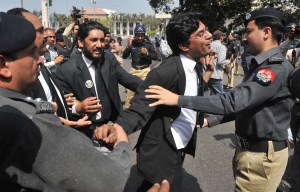
Lawyers and police clash in Lahore - photo by Rahat Dar

Lawyers and police clash in Lahore - photo by Rahat Dar

KARACHI, Mar 12 (IPS) – Barely a year after being elected, the Pakistan government faces a political storm involving a street agitation spearheaded by lawyers and opposition political parties allied with religious parties.

Lurking on the sidelines is an army unused to civilian command even as religious militants create havoc around the country.

None of this is new to Pakistan but many find it all the more painful given the hopes built up by last year’s general elections. On Feb 18, 2009, Pakistani voters overwhelmingly supported non-religious parties and rejected those that had been propped up by the army.

The electorate’s rejection of the religious parties and the joining hands of the late Benazir Bhutto’s Pakistan People’s Party (PPP) and her former rival Nawaz Sharif’s Pakistan Muslim League-Nawaz (PML-N) raised expectations of an end to political confrontation and religion-based politics – and the army moving away from politics.

These expectations followed decades of misrule and exploitation of religion for political purposes. The Pakistani establishment, at Washington’s behest, strengthened armed militancy, exploiting religious sentiments to drive the Soviets out of Afghanistan during the 1980s. In the process they created ‘Jihad International’, as the late scholar Dr Eqbal Ahmad termed it.

This may now be the biggest threat facing Pakistan – and the world – since the attack on the World Trade Center on Sep. 11 2001. Since then Washington has pushed Islamabad to fight the very forces of militant Islam that both together had fostered and strengthened.

Resultantly, this country has, as Pakistanis point out, suffered the most from militant attacks.

In this situation, political instability is distracting at best and dangerous at worst. The ‘long march’ demanding the reinstatement of chief justice Iftikhar Mohammed Choudhry, spearheaded by the legal fraternity and sections of civil society, has ready allies among the right-wing political opposition.

This includes Sharif’s PML-N and the Jamaat-e-Islami, a mainstream religious party sympathetic to militant Islam, as well as others sympathetic to the Taliban, like ex-chief Inter-Services Intelligence (ISI) and anti-India hawk Gen. (retd.) Hamid Gul, retired bureaucrat Roedad Khan who brutally quashed political opposition during the Zia years, and cricket hero-turned politician Imran Khan, chief of the Tehrik-e-Insaaf (Movement for Justice).

All these forces boycotted the 2008 polls, except Sharif who rescinded his boycott decision after Bhutto convinced him that elections were the only way forward.

Long-festering tensions between the PPP and PML-N came to a head with a Supreme Court ruling of Feb 25 barring Sharif and his brother Shahbaz Sharif from holding elected office. Bhutto’s widower, President Asif Ali Zardari is widely believed to be behind this controversial ruling.

The disgruntled Sharifs, already pushing to restore Chief Justice Choudhry, have flung themselves wholeheartedly into the long march – a move that observers do not see as entirely altruistic since their stated aims include effecting regime change.

“Sharif’s attempts to paint himself as a radical, grassroots activist are at odds with his political origins,” commented former lawyer and Australia-based analyst Mustafa Qadri, writing about the opportunity Pakistan’s politicians of all hues have wasted in their “refusal to look beyond personal power games and provincialism to develop the nation’s still embryonic democracy”.

The Sharifs gained prominence as businessmen patronised by General Zia -ul-Haq who was behind Pakistan’s “transformation from majority-Muslim nation to Islamic state with more conservative religious seminaries per capita than any other country in the world,” as Qadri put it (‘Long march to nowhere’, The Guardian, Mar 10, 2009).

The current imbroglio comes on the heels of loaded statements by Gen. (retd) Pervez Musharraf who during a visit to India last week, gave several talks and interviews in which he hinted at a possible political comeback.

Curiously Musharraf, who stepped down as president in August 2008, urged New Delhi to stop ‘bashing’ the Pakistan army and the shadowy ISI since, according to him, they were the best defence against the growth of the Taliban and militancy in Pakistan.

President Zardari has invited comparisons to Musharraf because of his government’s use of police force and mass arrests to prevent the long march, as Musharraf did after suspending Choudhry in March 2007 and imposing Emergency rule in Nov 2007.

The irony is illustrated by the recent three-hour detention of the firebrand women’s rights and political activist, Tahira Abdullah, who has been mobilising the lawyers’ movement from her home in Islamabad.

She faced police batons and tear gas in the Zia and Musharraf eras. A day before the long march began, a police contingent arrived at her house and virtually broke down her kitchen door.

However, her arrest attracted media attention, embarrassing the government into quickly ordering her release. An undeterred Abdullah immediately resumed mobilising for the agitation.

“It is sad and ironic that the PPP government has come to this,” she told IPS. “They said it was preventive detention. They can’t catch people like (Taliban leaders) Baitullah Mehsud and Maulvi Fazlullah but they send police after me, a very ordinary person.”

There is also irony in progressive, secular activists like Abdullah joining hands with the emerging right-wing coalition to achieve a shared goal, the restoration of Choudhry.

Civil society activists privately admit that otherwise their numbers are too small to reach the critical mass needed to effect political change.

“There are only a handful of us,” one of them told IPS. “And there are no more than 100,000 lawyers in the country. So we have to join hands with political forces who agree with us on this matter even if we don’t agree on other matters. We know they are using us, but we are also using them.”

Observers like the political economist and former student activist S.M. Naseem fear that this kind of mutual ‘using’ could push Pakistan further towards right-wing forces.

Disappointed by the performance of the government as well as the opposition, he holds that the lawyers’ movement has missed the opportunity of creating a new polity in the country. “They should have broadened the agenda to create a new political system,” he told IPS. “Two years for the restoration of one person (Choudhry), however, honest and bold, is a bit too much.”

Prime Minister Yusuf Raza Gillani has said that he cannot, in all conscience, oppose the long march. “We have also participated in street agitations and long marches,” he said. “How can we stop anyone else from exercising their democratic right to do so?”

This stand appears to pit him against President Zardari, holding an office strengthened by past military dictators. The President’s powers include being able to dismiss the prime minister and dissolve government – as several presidents before him have done. This is unlikely to happen now. For Zardari to take such a step would mean dismissing his own government.

Having recently obtained a majority in the Senate, the PPP can conceivably push through the constitutional amendments it proposed in May 2008 for which a two-thirds majority in the National Assembly and the Senate is required. These amendments include the removal of the 17th amendment that allows the President to dismiss government.

Moves towards reconciliation between the PPP and the PML-N continue behind the scenes, even as the long march kicks off with lawyers and political activists from various cities heading towards Islamabad to converge by Mar. 6 for a dharna (or sit-in) ‘until the Chief Justice is restored’.

Observers fear a breakout of violence even though the long march leaders have promised to keep matters peaceful.

(END/2009)

http://www.ipsnews.net/news.asp?idnews=46083

More on women – and Rahman Baba

Sangota Girls Public School, Swat, destroyed by militants. Photo by Kamran Arif

Sangota Girls Public School, Swat, destroyed by militants. Photo by Kamran Arif

Forgot to include the following in my posting focusing on women

AMMU JOSEPH’s article ‘Our freedom is at stake’ is linked to the issues Kalpana Sharma identified in her article on the attacks women in India are facing, which as I wrote, looks like an Indian version of the Vice & Virtue dept of the Taliban that we are facing here in Pakistan. Ammu’s Bangalore Mirror article of Feb 12 (but still very relevant) at

http://tinyurl.com/clhdzy

And now to RAHMAN BABA: As the political confrontation heats up in Pakistan ahead of the lawyers’ long march, joined by the Sharifs who were disqualified from politics recently, before all this reaches a stage where it overtakes all other discourse (which it already seems to have, to an extent), wanted to post a few items related to the disturbing attack on Rahman Baba’s shrine near Peshawar on March 5. The attack caused widespread outrage and practically every paper took it up. The incident took place just two days after the March 3 attack on the Sri Lankan cricketers in Lahore that led to a knee-jerk reaction among many Pakistanis blaming India for the attack.

Countering the culture of blame-counter blame, Siddharth Varadarajan, Associate Editor The Hindu, wrote on March 4 that finding ways to “encourage Pakistani cooperation and, more generally, to stabilise that country, are the most important challenges facing Indian diplomacy”. See his article ‘Lahore attack shows urgency of joint action on terror’ – Forget the conspiracies, the threat to Pakistan and India is the same – http://tinyurl.com/au8xhy

I thought he was spot on, on the whole and had a comment to add to his statement that “Cricket is the most visible icon of secular Pakistan, and perhaps the only competitor militant Islam faces in its struggle to tame the wayward Pakistani mind.”

I wrote: “There is another, even more deep-rooted competitor militant Islam faces – the widespread adherence to Sufi Islam and values, superstition, taweez dhaga (tying threads, getting amulets) etc. I fear (hope hope hope I am wrong) a major attack on any urs (birthday celebrations of Sufi saints) taking place at any of the major shrines any time soon…”

The following day, militants bombed the shrine of the 17th century Sufi poet Rahman Baba. An AP report in the Independent commented that the attack highlighted “the gulf between hard-line Muslims and many in the region who follow a traditional, mystical brand of Islam… A professor at Peshawar University told a local TV station that in many Pashtun homes, Baba’s poems are kept alongside the Islamic holy book, the Quran.” http://tinyurl.com/b45yo5

The caretaker of the shrine said he had got a letter three days before the attack warning against the perpetration of this “shrine culture” and objecting to the fact that women were coming to pray at the shrine. Militants used remote control bombs that destroyed the outer wall of the Mausoleum and partially damaged the building one month ahead of Baba’s urs, scheduled for April 5.

According to Pashtun Post <www.pashtunpost.com/>, Yousaf Ali Dilsoz, President of Rahman Baba Adabi Jirga says that Rahman Baba is the icon of Pashtuns spirituality and their love for peace and tolerance. “Saidu Baba, a revered saint from Swat valley, is known to have said that if the Pashtuns were ever asked to pray on a book other than the Koran, they would undoubtedly go for Rahman Baba’s work.”

Pashtun Post contains translations of some of Baba’s verses – http://tinyurl.com/c6neqy

Some excerpts:

Sow flowers so your surroundings become a garden
Don’t sow thorns; for they will prick your feet

If you shoot arrows at others,
Know that the same arrow will come back to hit you.

Humans are all one body,
Whoever tortures another, wounds himself.

(ends)

Focus on women – Pakistan, India, Afghanistan, a docu on Swat and more

Still from my film 'Mukhtiar Mai: The struggle for justice'

Still from my film 'Mukhtiar Mai: The struggle for justice'

A collection of articles published around March 8, including mine for IPS and The News, plus articles by Kalpana Sharma, Cassandra Balchin, Zofeen Ebrahim, Ayesha Khan (study on Lady Health Workers in Pakistan), link to a documentary on a Swat schoolgirl and more. Another post pending on issues around the attack on Rahman Baba’s shrine near Peshawar, will compile and post soon.

‘A new political context for Juliet’ – my article for The News on Sunday, about women speaking out all over the country, attempting to exercise their rights to personal autonomy – in a post-colonial age that harks back to medieval times when women were considered family property

Women Defy Militancy, Patriarchy – story for IPS outlining the twin threats of militancy and patriarchy that women face in Pakistan
http://www.ipsnews.net/news.asp?idnews=46024

In both articles, I refer to a documentary ‘Class Dismissed in Swat Valley’ (NYT) that focuses on Malala, an 11-year-old Pakistani girl on the last day before the Taliban close down her school. A must see – very moving and informative – profiling the great courage of ordinary people under adversity
http://tinyurl.com/avq4c9

I learnt of this film through an article that Shabbir Imam in Peshawar forwarded from the Anchorage Daily News by Shehla Anjum, a Pakistan-born writer based in Alaska, ‘Taliban wages war against girls’ education in Pakistan’. The writer followed up the story in the documentary by contacting Malala and her father.
http://tinyurl.com/dmxtld

The IPS website – http://www.ipsnews.net – contains a link to the other articles around Women’s Day –
http://www.ipsnews.net/new_focus/women/index.asp
This link includes other articles worth looking up, from Palestine and Afghanistan, and ZOFEEN EBRAHIM’S article about child marriage in Pakistan
http://www.ipsnews.net/news.asp?idnews=46022

KALPANA SHARMA in her column `The Other Half’ in The Hindu, Sunday Magazine, March 8, 2008, writes about the attacks women in India are facing – a chilling account of what looks like an Indian version of the Vice & Virtue dept of the Taliban that we are facing here in Pakistan…
http://tinyurl.com/bql9vg

CASSANDRA BALCHIN – a three-part series on the challenges faced by Muslim women around the globe and the debates within the Muslim world to deal with these challenges, the demand for equality within the family, and more, in Open Democracy – http://www.opendemocracy.net – I’ve shortened the three URLs for easy reference here:
Home truths in the Muslim family – The global pressure to reform Muslim family law is mounting
http://tinyurl.com/bxhf8v

Musawah: there cannot be justice without equality – Muslim scholars and activists from 48 countries launch a global initiative for justice with equality between men and women
http://tinyurl.com/akg2q8

Musawah: solidarity in diversity – a global initiative to reform Muslim Family Law finds solidarity in diversity and a growing convergence around human rights values.
http://tinyurl.com/bbvvhd

AYESHA KHAN’s recent study on LHWs and Women’s Empowerment in Pakistan can be accessed through the Collective for Social Science Research website
The study is at this link: http://tinyurl.com/cssr-lhv

Suicide Democrats

http://thenews.jang.com.pk/print1.asp?id=165518

Op-ed, The News Wednesday, March 04, 2009

Suicide Democrats

Raza Rumi

I am appalled by the recent events that have yet again stirred instability and uncertainty into Pakistani politics. Those of us who voted in last year’s elections expected that the political leaders and Pakistan’s political elites would learn a lesson from our unfortunate history.

We also expected the lawyers’ movement, headed by men of extraordinary calibre, to display sagacity and vision and contribute to the consolidation of a democratic culture. However, what we witnessed was a complete rejection of the Feb 18 polls by the leading lights of the movement, and a few other naïve political actors. When the electorate voted in large numbers and returned the two mainstream political parties to the parliament, the lawyers, instead of accepting that they were wrong to boycott elections, insisted on their narrow and bourgeois interpretation of the term “rule of law.”

Sadly, law, rights and constitutionalism are personalised through the idolisation of the deposed chief justice, as if Pakistan were still a mediaeval kingdom, where the bad King (Musharraf) had to be overthrown, and the good Qazi (Justice Iftikhar) had to be “restored” and vested with all moral, political, executive, military and judicial powers.

The rightwing media has further whipped this game and brought the popular and well-meaning Sharif in direct confrontation with the federal government on this single issue. President Zardari, whom we all hoped had learned his lessons from jail, endless court trials and exile, would act with vision and leadership. Similarly, the Supreme Court, led by Justice Dogar, might have gone an extra mile to prove its neutrality. Alas, how wrong we were!

It is amazing that the long marches, threats of violence and agitation, and questionable imposition of the governor’s rule in the largest province of the country are taking place at a time when the Taliban are capturing one district after another. The media and civil society, instead of bringing down the creaky edifice of democracy, should be pressurising political leaders to act with maturity and not wrangle.

Given the hysteria of the last few days, since the disqualification of the Sharif brothers, the media is portraying the situation as one with no solution. Enemies of democracy, the traditional forces that have always sabotaged civilian rule, are smiling at this imbroglio. There is no paucity of solutions: there are legal and constitutional means whereby the legislature can amend the Constitution on the eligibility of politicians to contest elections and hold offices. A review petition can always be filed that could look at the questions of law pertaining to this matter. Similarly, the promulgation of another NRO is not beyond the realm of the possible. Politics is about bargains and adjustments to strengthen the representative system, rather than bringing it down at every inconvenient juncture.

The PPP must take the initiative to avoid further fissures in the tenuous federation called Pakistan. The current posturing and gung-ho behaviour of the PPP’s Punjab leaders need to be arrested by the central leadership. The PML-N and, in particular, its Quaid, Mian Nawaz Sharif, should also rise above the rhetoric of the 1990s and display flexibility that is essential to a functional democracy. The PML-N has little support in the three smaller provinces of Pakistan and its current rhetoric and thundering against President Zardari, who represents the smaller federating units, is not a good omen. A group of political activists torched the memorial of Benazir Bhutto in Rawalpindi, and there have been strong reactions across the country, especially in Sindh. Why blame the bomb blasts at funerals and mosques when such is the prevalent culture of protest.

If the deposed chief justice has to be restored then the matter must be brought before the parliament and solved through constitutional means. One cannot play the politics of constitutionalism and find solutions in executive orders. If Mr Sharif will lead an agitation with the lawyers who are now placed on the other side of the democratic divide, he will not only engineer the fall of the central government, and the PPP, but will also sign the deed of death for the future of democratic politics in Pakistan.

Over fifty deposed judges have taken fresh oaths under the policy of the sitting government. When the incumbent judiciary is trampled and defamed, the detractors forget that it includes all those judges who resisted Musharraf’s emergency. Once an individual is restored to the top slot, will it become legitimate overnight or the incumbent judges would be fired for being part of the “naqli” judiciary?

The civic activism since 2007 was a harbinger of change in Pakistan. The lawyers’ movement is de-legitimising democracy and political parties (including the largest and perhaps the only national party). One may ask whose purpose is being served here. Is it not what the leaders of the Taliban and other extremist groups maintain about democracy by calling it “kufr”?

The establishment and its proxies must not win this game. At present it seems that both the mainstream political parties and their obstinate leaders are bound to create a situation similar to 1958, 1977 and 1999. However, this time the cost of unrest and confrontation will be detrimental to our future. The vicious cycle, emanating from our inability to handle political squabbles, will this time give way to erosion of democratic space won today with sacrifices, toils and struggles.

The writer blogs at razarumi.com and edits two e-zines: Pak Tea House and Lahore Nama. Email: razarumi@gmail.com

POLITICS-PAKISTAN: Court Ruling May Deepen Political Crisis

http://www.ipsnews.net/news.asp?idnews=45893

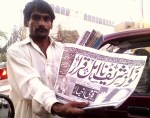
"Nawaz Sharif disqualified" reads the headline

Analysis by Beena Sarwar

KARACHI, Feb 26 (IPS) – The political chasm in crisis-riddled Pakistan has deepened after a Supreme Court ruling barred from political office opposition leader Nawaz Sharif and his younger brother Shahbaz Sharif, chief minister of Punjab – the country’s most populous and powerful province.

The Sharifs’ Pakistan Muslim League – Nawaz (PML-N) party had joined hands with President Asif Ali Zardari’s Pakistan People’s Party (PPP) to defeat political parties supporting former president Pervez Musharraf in elections last February, and force his resignation six months later.

But the alliance between Pakistan’s two main political parties fell apart, mainly over the restoration to office of chief justice Iftikhar Mohammed Choudhry – whose dismissal by Musharraf in 2007 sparked unrest led by the legal fraternity.

“The move [Wednesday’s apex court ruling] plunges Pakistan back into familiar territory,” said PML-N parliamentarian Ayaz Amir, talking to IPS on the phone from the capital Islamabad. “Another crisis, another round of turbulence… We seem to be cursed with the Chinese saying, ‘may you live in interesting times’.”

For most, the Supreme Court ruling – which upheld a lower court verdict, last June, that made Nawaz Sharif ineligible to stand for elections on airplane hijacking charges – has come “like a bolt from the blue,” as Asha’ar Rehman, resident editor of the daily ‘Dawn’ in Lahore put it.

“The political repercussions will be horrific. We were hoping they would show some maturity and let a reconciliation happen,” added Rehman, talking to IPS from Lahore, capital of the Punjab and the stronghold of the Sharifs.

Iqbal Haider, advocate and chairman of the independent Human Rights Commission of Pakistan, termed the decision as being “against democracy, not against the Sharif brothers’’.

In a no-holds barred press conference at his Lahore residence, shortly after the court ruling, a belligerent Nawaz Sharif said he had no problems with the PPP, but held the party head, Zardari, directly responsible for the contentious judgement.

Sharif, a former prime minister, also accused Zardari of offering a “business deal” to Shahbaz Sharif, asking him to support the government in extending the tenure of the current chief justice in return for which the court would provide the brothers with relief.

Presidential spokesman Farhatullah Babar dismissed these charges as a knee-jerk response. “The allegations that PML-N chief has levelled against President Zardari are far from reality and are based on ill intention,” he told a press conference in Islamabad later that evening.

Information Minister Sherry Rehman called for examining the court ruling dispassionately while admitting it had created a problem for the government in its efforts for reconciliation.

Many PPP parliamentarians, although unhappy about the decision, say there is unfortunately nothing the party can do in this regard.

The ruling is seen a “technical knockout” for the Sharif brothers who now also stand barred from contesting elections.

“More than anything, it undermines the democratic legitimacy of the government,” political analyst and economist Asad Sayeed told IPS. “Nawaz Sharif is a popular political leader. This decision will push him to the wall and perhaps further towards the religious parties.”

Within hours, President Asif Ali Zardari imposed direct central rule in the Punjab for two months. Defending the decision, a PPP spokesperson cited potential “anarchy” as angry activists took to the streets after Sharif in a press conference exhorted people to come out in protest.

The government wisely refrained from using police force to prevent the protests, as angry activists in various cities burned tyres, blocked traffic, and attacked property. In Rawalpindi, some even destroyed posters of former prime minister Benazir Bhutto and damaged the memorial at the public park where she was assassinated on Dec. 27, 2008.

‘Religious militants’ are widely believed to be behind her murder, barely two weeks before the scheduled polls which Bhutto had convinced her former rival Nawaz Sharif to contest, instead of boycotting them as he was planning to do.

Both twice-elected and twice-removed prime ministers had then returned from several years of exile abroad. During this time, army chief Pervez Musharraf headed Pakistan, after ousting Nawaz Sharif from the prime ministership in 1999.

Sharif had tried to replace the army chief and prevent the civilian flight bearing Musharraf back from an official visit to Sri Lanka, from landing in Pakistan. This was the ‘hijacking’ case for which Sharif was convicted, grounds now for his disqualification from public office or contesting elections.

Bhutto’s return to politics in Pakistan in October 2007 was widely seen as part of a ‘deal’ brokered by Washington to restore civilian rule in Pakistan in order to better handle the ‘war on terror’ – for which policy makers were by now prescribing a political rather than a military solution.

The widespread secular movement led by lawyers to restore chief justice Choudhry had also presented the possibility of progressive political change in Pakistan.

After the general elections of Feb. 18, 2008, the PPP and PML-N had agreed to form government as well as to restore the judges whom Musharraf had removed when he imposed emergency rule on Nov. 3, 2007.

“What people forget about the agreement was that it was also about government formation – the other two clauses were how the federal and the provincial governments were going to be formed,” said Asad Sayeed.

“Nawaz Sharif insisted on the judges’ restoration in order to undermine the PPP. They could not have moved towards forming government if Zardari had not agreed on this clause because Sharif was not willing to talk about it.”

Sharif continued to push for the restoration of chief justice Iftikhar Mohammed Choudhry. Most of the other judges ousted after Musharraf’s November 2007 emergency have since been reinstated after taking fresh oath of office.

The country was bracing for a lawyers’ ‘long march’ to restore Choudhry, scheduled to kick off on Mar. 12 and ending with a sit-in or ‘dharna’ in Islamabad. The PML-N has enthusiastically supported the move.

Ayaz Amir, who has warned against making the restoration of Choudhry the “be all and end all” of politics, told IPS he felt his PML-N party had “stuck its horns too much into this one issue”.

The planned long march, Amir predicted, ”will get more momentum now, but it won’t restore the judges. There will be more instability and tumult, with politicians being further discredited in the public eye”.

More ominously, widespread unrest could also leave the army with “no choice” but to step in – something it is, at this point, clearly reluctant to do.

Amir hopes it will not come to that. “We’re not at that point yet. We have to wait and see what happens when the situation plays itself out.”

Bitter political acrimony is not new in Pakistan. However, so far both the PPP and PML-N have kept their main shared goal before them -to keep the army out of politics and let the political process continue. Observers hope that this long view will prevail.